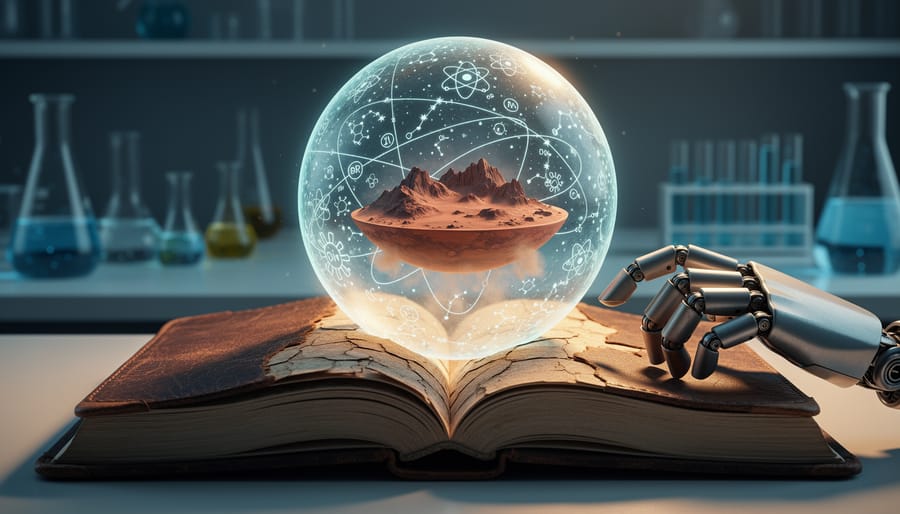
Science fiction transforms abstract scientific concepts into vivid, memorable stories. From Isaac Asimov’s exploration of robotics and artificial intelligence to Kim Stanley Robinson’s detailed terraforming projects on Mars, the genre gives form to ideas that might otherwise remain trapped in academic journals and laboratory notebooks. These narratives don’t just entertain; they create mental frameworks for understanding everything from quantum mechanics to ecological collapse, making complex science accessible through character, conflict, and consequence.
The examples that follow span nearly a century of storytelling, each selected for how effectively it translates a specific scientific discipline into narrative form. You’ll find works that predicted technological breakthroughs decades before they arrived, stories that wrestled with ethical dilemmas scientists now face in real laboratories, and speculative futures built on rigorous extrapolation from current research. Some prioritize hard scientific accuracy, calculating orbital mechanics and energy budgets with precision. Others take a single provocative idea and follow its social implications to their logical extreme.
What makes these 12 examples particularly valuable is their range. Biology, physics, computer science, climatology, neuroscience, and more each find expression through different narrative approaches. Classic novels sit alongside contemporary works, demonstrating how the conversation between science and fiction evolves as our understanding deepens. Whether you’re a writer seeking models for your own scientific storytelling, a student looking for engaging ways to understand complex concepts, or simply a reader curious about where imagination meets evidence, these selections offer clear templates for how scientific thinking can fuel powerful narratives.
How We Curated This Science Fiction Collection
Choosing twelve works from the vast landscape of science fiction required clear standards. This isn’t a popularity contest or a comprehensive history lesson, it’s a deliberate selection designed to show how scientific thinking shapes memorable narratives.
Our selection criteria focused on four core principles:
- Demonstrated integration of specific scientific disciplines into plot and character development, not just set dressing
- Balance between factual accuracy and imaginative extrapolation that respects real science while pushing boundaries
- Representation across multiple fields, from physics and biology to anthropology and linguistics, to showcase the breadth of science-inspired fiction
- Temporal range spanning nearly two centuries, from pioneering nineteenth-century works to contemporary voices
- Track record of inspiring actual scientific curiosity or discourse beyond the fiction community
Each example demonstrates how a particular scientific concept or methodology becomes inseparable from the story itself. We prioritized works where removing the science would collapse the narrative structure, not merely change the backdrop. Some entries are towering classics that established enduring patterns; others represent recent innovations in how science and storytelling intersect. What unites them is their commitment to making scientific thinking feel essential rather than ornamental.
1. Mary Shelley’s Frankenstein, The Birth of Bioethics in Fiction
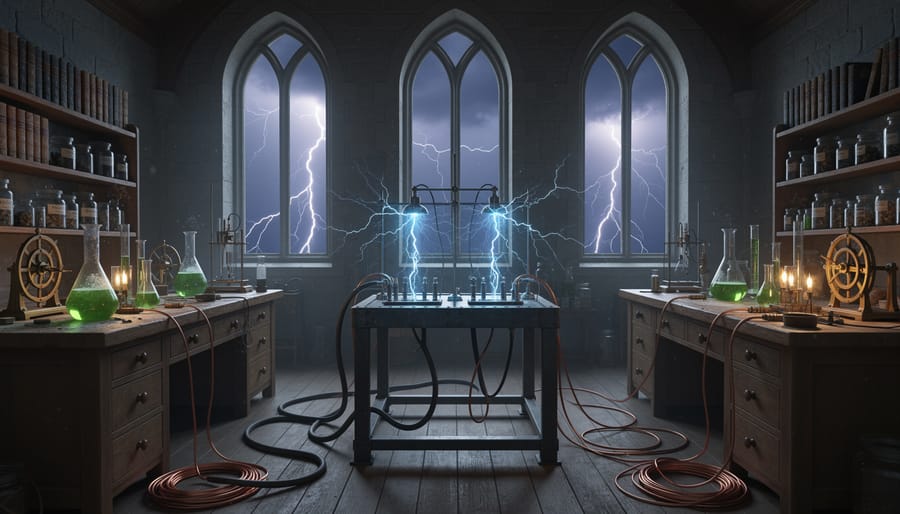
Mary Shelley’s 1818 novel arrived at a moment when galvanism, the controversial practice of using electricity to stimulate muscle tissue, dominated scientific and public discourse. Luigi Galvani’s experiments with frog legs had demonstrated that electrical current could animate dead tissue, while Giovanni Aldini took the spectacle further by publicly applying voltaic piles to human corpses. Shelley attended lectures on these experiments and incorporated them into Victor Frankenstein’s reanimation process, grounding her supernatural-seeming achievement in actual laboratory practice.
What makes Frankenstein revolutionary isn’t just this scientific foundation. It’s how Shelley used galvanism as a narrative vehicle to explore consequences rather than celebrate discovery. Victor’s technical success becomes his moral failure. He achieves biological reanimation but abandons ethical responsibility for his creation, triggering a cascade of tragedies that stem directly from his refusal to consider the social and philosophical implications of his work.
This structure, scientific breakthrough followed by unforeseen ramifications, became the template for science-inspired fiction. Shelley didn’t write a treatise on electrical experiments. She crafted a story where the science serves as both catalyst and cautionary framework, forcing readers to confront questions about creation, responsibility, and the limits of human ambition that remain urgent two centuries later. The creature’s eloquent demand for recognition positions him not as a monster but as the consequence of unchecked scientific hubris, a theme that echoes through every subsequent work exploring bioethics in fiction.
2. Jules Verne’s Twenty Thousand Leagues Under the Sea, Engineering Imagination
Jules Verne published Twenty Thousand Leagues Under the Sea in 1870, decades before the first functional military submarine. Yet his Nautilus wasn’t fantasy, it drew from genuine naval architecture, emerging electrical theories, and documented marine phenomena. Verne consulted engineering journals, corresponded with maritime experts, and studied oceanographic surveys to ground his vessel in mechanical possibility. The result was a submarine powered by sodium-mercury batteries (speculative but chemically plausible), equipped with diving suits that anticipated actual designs, and capable of depths that challenged but didn’t mock the physics of pressure and buoyancy.
What makes this work exemplary isn’t just the hardware. Verne populated his ocean with real species, the giant squid attack references documented cephalopod encounters, and described bioluminescence, ocean currents, and underwater geology with precision that oceanographers later validated. He didn’t invent a magical sea; he extrapolated from incomplete but accurate knowledge, showing readers what lay beneath waves they’d never pierce.
This approach created a template: rigorous research generates credibility, which in turn amplifies wonder. When Captain Nemo navigates by actual stellar positions and harvests electricity from seawater’s chemical potential, the adventure feels earned rather than conjured. Verne proved that constraints sharpen imagination. His Nautilus worked because he understood what made real ships fail.
3. H.G. Wells’ The Time Machine, Physics Meets Social Commentary
When H.G. Wells published The Time Machine in 1895, he wasn’t simply spinning a tale of temporal adventure. He was grappling with two profound scientific conversations of his era: thermodynamics and evolutionary theory. The novel’s depiction of time as a dimension that could theoretically be traversed drew from emerging physics concepts, particularly the second law of thermodynamics and its implications for the universe’s eventual heat death.
Wells transformed these abstract principles into visceral narrative. His Time Traveller doesn’t just move through years, he witnesses entropy in action, observing humanity’s descent from Victorian civilization to the fragmented Eloi and Morlocks of 802,701 AD, then continuing forward to a dying Earth beneath a blood-red sun. This progression mirrors thermodynamic decay on both biological and cosmic scales.
The genius lies in Wells’s dual application of evolutionary biology. Drawing from Darwin and contemporary debates about degeneration theory, he imagined how natural selection might fracture humanity into separate species based on class divisions. The delicate, childlike Eloi and the subterranean, predatory Morlocks represent evolutionary endpoints of the Victorian upper and working classes, making social commentary inseparable from scientific extrapolation.
This fusion established a template: using rigorous scientific thinking not merely as window dressing, but as the structural foundation for examining human society. Wells proved that accurate scientific projection could sharpen social critique rather than distract from it.
4. Arthur C. Clarke’s 2001: A Space Odyssey, Orbital Mechanics and Consciousness

Clarke’s collaboration with Stanley Kubrick produced a narrative where the physics of spaceflight receives the same careful attention as the philosophical questions surrounding machine intelligence. The rotating space station and the realistic depiction of zero gravity in 2001: A Space Odyssey weren’t artistic flourishes, they emerged from Clarke’s meticulous calculations of orbital velocities, trajectories, and the mechanics of transferring between Earth orbit and lunar orbit. He understood that a wheel-shaped station spinning to create artificial gravity through centrifugal force was more than set dressing; it was a demonstration of how humans might actually live and work in space.
What makes this work exceptional as science-inspired fiction is how Clarke applied the same rigorous thinking to speculative territory. The HAL 9000 computer wasn’t a simple villain but an exploration of what machine consciousness might look like if it emerged from logic systems, an idea that seemed remote in 1968 but feels prescient now. Clarke wove evolutionary biology into the narrative through the monolith’s influence on human development, suggesting that technological advancement might be guided rather than random. The Jupiter mission’s depiction of long-duration spaceflight, complete with hibernation pods and the psychological isolation of deep space, drew on emerging space medicine research.
This dual commitment, engineering precision anchoring philosophical speculation, showed how hard science could amplify rather than constrain imaginative storytelling.
5. Ursula K. Le Guin’s The Left Hand of Darkness, Anthropology and Gender Science
Le Guin’s 1969 novel stands as a masterwork of anthropological speculation, constructing the winter world of Gethen with the same methodical attention an ethnographer brings to fieldwork. She drew directly from cultural anthropology, her father Alfred Kroeber was a renowned anthropologist, to build a society where inhabitants remain gender-neutral except during a brief fertile period called “kemmer,” when they can become either male or female.
This wasn’t mere fantasy window-dressing. Le Guin was engaging with emerging gender studies and anthropological theories about how biological sex shapes social structures, asking what human civilization might look like stripped of permanent gender roles. The Gethenians have no concept of gender-based labor division, no assumptions about who nurtures or who leads. Their politics, family structures, and even their relationship with aggression differ fundamentally from Earth societies.
The novel’s scientific backbone lies in its systematic exploration of variables. By changing one biological fact, ambisexuality, Le Guin revealed how deeply gender permeates human culture, from pronouns to power structures. She approached worldbuilding like a controlled experiment, isolating a single variable to observe cascading effects across an entire civilization.
What makes this example particularly potent is its continuing relevance. As gender studies has evolved and neuroscience has complicated our understanding of sex and identity, Le Guin’s thought experiment remains sharp. She demonstrated that rigorous speculative anthropology could generate insights about our own species that direct observation might miss.
6. Carl Sagan’s Contact, The SETI Protocol in Narrative Form
Carl Sagan’s Contact stands apart in science fiction for its radical commitment to procedural realism. Published in 1985, the novel meticulously depicts how astronomers would actually detect, verify, and decode an extraterrestrial signal, complete with the bureaucratic hurdles, funding uncertainties, and peer review processes that define real scientific work.
Sagan, an astronomer who contributed to SETI research, embedded authentic radio telescope operations throughout the narrative. Protagonist Ellie Arroway doesn’t stumble upon aliens during a dramatic crisis; she discovers the signal during routine data analysis, exactly as such a discovery would likely occur. The novel walks readers through spectral analysis, the challenges of distinguishing artificial signals from natural phenomena, and the international protocols for confirming such findings.
What makes Contact particularly instructive is how Sagan treats scientific method as dramatic tension. The months-long verification process, the skepticism from competing researchers, the political maneuvering around disclosure, these aren’t obstacles slowing the “real” story. They are the story, showing that scientific discovery involves human systems, not just individual genius.
The novel’s detailed exploration of prime number sequences as universal communication, the engineering challenges of building the Machine, and the physics implications of traversing vast distances all emerge from Sagan’s actual research interests. He demonstrated that rigorous scientific plausibility doesn’t dilute narrative power, it enhances authenticity and stakes.
7. Greg Bear’s Blood Music, Nanotechnology and Biological Complexity

Greg Bear’s 1985 novel Blood Music stands as a prophetic examination of nanotechnology and self-organizing biological systems, published years before the field matured into mainstream science. Bear built his narrative on legitimate principles from molecular biology, cellular communication, and complexity theory, then extrapolated them into terrifying territory.
The story follows a biotech researcher who creates intelligent microorganisms by reengineering their DNA to enhance processing capabilities. Bear grounded this premise in actual genetic manipulation techniques, but his genius lay in exploring what happens when biological entities gain the ability to communicate and evolve at accelerated rates. The novel doesn’t just feature genetic engineering as a plot device, it wrestles with emergent properties, the concept that complex systems can exhibit behaviors unpredictable from their individual components.
What makes Blood Music particularly valuable as science-inspired fiction is Bear’s treatment of scale and perspective. As his engineered cells multiply and evolve, he shifts viewpoints from human to microscopic, forcing readers to consider consciousness and intelligence as phenomena that might emerge at any organizational level. This mirrors real debates in biology about cellular intelligence and distributed cognition.
Bear consulted with researchers during his writing process, ensuring his speculative leaps launched from solid ground. The result demonstrates how rigorous scientific thinking can amplify rather than constrain imaginative storytelling, creating narrative tension from legitimate questions about where biotechnology might lead.
8. Kim Stanley Robinson’s Mars Trilogy, Planetary Engineering as Character
Robinson’s Mars trilogy, *Red Mars*, Green Mars, and *Blue Mars*, transforms planetary science from backdrop into protagonist. Rather than treating terraforming as a convenient setting, Robinson spent years consulting with NASA scientists, geologists, and ecologists to map a plausible 200-year engineering project that would make Mars habitable.
The geology isn’t window dressing. Robinson details specific mineral compositions, volcanic formations, and regolith chemistry that determine where settlements go and how they extract resources. His characters debate the thermodynamics of warming the atmosphere, the practicalities of releasing subsurface CO₂, and whether crashing ice asteroids into the polar caps would deliver enough water vapor. These aren’t asides, they’re the engine of political conflict, as different factions argue whether to preserve Mars’s native state or reshape it entirely.
The atmospheric science drives the trilogy’s arc. Robinson tracks atmospheric pressure increases, UV radiation levels, and temperature gradients across decades, showing how each incremental change enables new organisms and human activities. He grounds speculative terraforming in real principles: albedo modification through dust distribution, greenhouse gas introduction via engineered microbes, hydrological cycle establishment.
What elevates this beyond engineering documentation is Robinson’s integration of ecology and ethics. His scientists wrestle with unintended consequences, introducing lichen accelerates soil formation but may crowd out later species. The trilogy demonstrates how rigorous scientific worldbuilding creates narrative tension that transcends simple adventure plots, making the planet itself a character undergoing transformation.
9. Ted Chiang’s Story of Your Life, Linguistics and Physics Intertwined
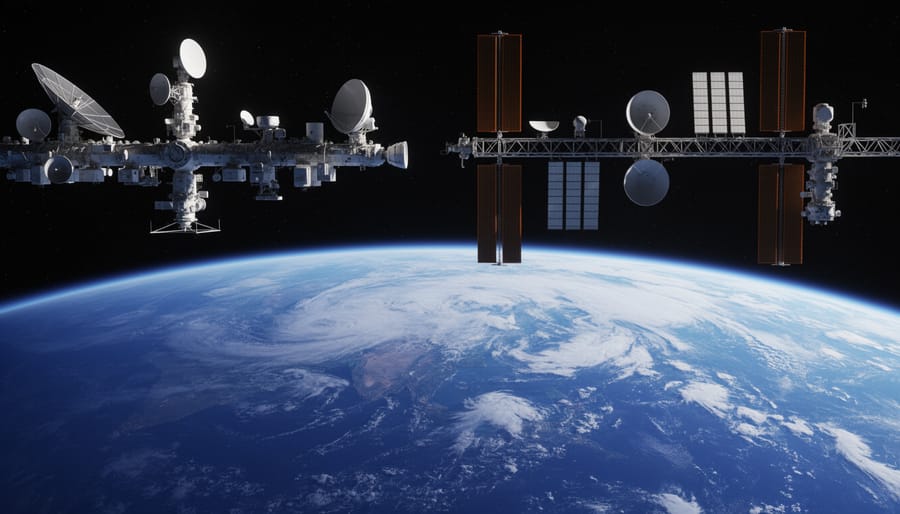
Ted Chiang’s “Story of Your Life” operates at the intersection of linguistic theory and physics in ways few narratives attempt. The novella centers on Louise Banks, a linguist learning an alien language called Heptapod B, which structures thought according to Fermat’s principle of least time, a concept from optics stating that light travels the path requiring minimum time between two points. As Louise masters this visual, simultaneous language, her perception of time shifts from sequential to all-at-once, allowing her to experience her entire life as a unified whole rather than a linear progression.
Chiang draws directly from the Sapir-Whorf hypothesis, the linguistic relativity theory proposing that language shapes cognition and worldview. He pushes this premise into physics territory by suggesting a language could fundamentally alter temporal perception itself. The Heptapods experience time non-linearly because their language encodes meaning through interconnected logograms that must be understood as complete units. Each sentence exists as a single, complex symbol where the beginning and end inform each other simultaneously.
This isn’t mere metaphor. Chiang grounds the narrative in Fermat’s principle and variational mechanics, demonstrating how if consciousness could truly perceive events teleologically, knowing endpoints before taking action, human experience would transform entirely. The story became the foundation for the film Arrival, but the novella’s mathematical rigor distinguishes it as science-inspired fiction that treats linguistic and physical concepts with equal seriousness.
10. Andy Weir’s The Martian, Survival Through Applied Science
Andy Weir’s The Martian stands apart in science-inspired fiction through its relentless commitment to showing work. When botanist-astronaut Mark Watney finds himself stranded on Mars, the novel doesn’t skip to miraculous solutions, it walks readers through every calculation, every chemical reaction, every engineering workaround needed for survival.
The narrative treats scientific problem-solving as drama. Watney must generate water by burning hydrazine rocket fuel to produce hydrogen, then combining it with oxygen in a controlled reaction. Weir provides the chemistry: N₂H₄ + catalyst → N₂ + 2H₂, then 2H₂ + O₂ → 2H₂O. The reader follows each dangerous step, understanding why an accidental spark could turn the habitat into a fireball. This isn’t background color; the chemistry is the plot.
The botany of growing potatoes in Martian regolith mixed with human waste becomes similarly central. Weir details the nitrogen cycle, the pH adjustments, the careful rationing of water, transforming soil science into suspense. When a habitat breach kills the crop, readers grasp the loss because they’ve understood the months of cultivation.
Orbital mechanics drives the rescue attempt. Weir calculates transfer windows, delta-v requirements, and trajectory corrections with NASA-grade precision. The climax hinges on understanding how velocity, mass, and atmospheric drag interact, concepts explained through Watney’s survival decisions rather than expository asides.
This approach redefined hard science fiction for a mainstream audience, proving that rigorous science intensifies rather than interrupts storytelling.
11. Liu Cixin’s The Three-Body Problem, Astrophysics Meets History
Liu Cixin’s The Three-Body Problem demonstrates how hard science fiction can bridge cultural divides while tackling one of celestial mechanics’ most persistent puzzles. The novel takes its title from an actual unsolved problem in physics: predicting the motion of three gravitating bodies with precision remains mathematically impossible beyond certain timeframes, creating inherent chaos in systems as simple as three stars orbiting each other.
Liu doesn’t merely reference this problem as window dressing. He constructs an alien civilization living on a planet caught in a chaotic three-sun system, where survival depends on predicting unpredictable stellar movements. The Trisolarans’ entire culture, technology, and desperate search for a stable world stem directly from gravitational mechanics that readers can verify in astrophysics textbooks. This creates genuine tension: the science isn’t simplified or softened, yet it propels every plot turn.
What elevates the work beyond pure physics is Liu’s grounding in China’s Cultural Revolution. Scientific persecution, institutional destruction, and the human cost of ideology form the novel’s emotional core. Ye Wenjie’s disillusionment with humanity after witnessing her father’s murder at a struggle session isn’t background flavor, it’s the catalyst for the entire trilogy’s cosmic-scale conflict.
Liu proves that scientific rigor and cultural specificity reinforce rather than dilute each other. His approach expanded science fiction’s geographic and intellectual range, showing Western readers how different historical experiences shape responses to the same universal scientific questions.
12. Becky Chambers’ The Long Way to a Small, Angry Planet, Biology and Social Systems

Becky Chambers’ debut novel presents a refreshingly grounded approach to speculative biology, using a multi-species crew aboard a tunneling ship to explore how different evolutionary paths shape social organization. Rather than treating alien biology as mere set dressing, Chambers builds her narrative around the premise that physiology determines social possibility.
The novel’s strength lies in its attention to ecological thinking. The Aandrisk species, for example, evolved from pack hunters, creating societies that value collective decision-making and fluid gender expression tied to social role rather than reproduction. The insectoid Grum developed from hive organisms, leading to individual psychology that prioritizes group harmony in ways human characters initially misread as passivity. Each species’ biology isn’t just different, it creates fundamentally incompatible assumptions about what constitutes proper social behavior.
Chambers draws on real principles from evolutionary biology and animal behavior studies. Her Sianat Pairs, two beings sharing merged consciousness, reference research into symbiotic relationships and distributed cognition. The various oxygen requirements, dietary needs, and communication methods aboard the Wayfarer mirror the complexity ecologists face when studying interdependent ecosystems.
What makes this example particularly relevant is how Chambers uses speculative biology to examine coexistence itself as a scientific problem. The crew’s daily negotiations, accommodating different circadian rhythms, respecting varied personal space requirements, managing incompatible dietary restrictions, frame diversity not as moral abstraction but as practical engineering challenge requiring systematic solutions.
The Science Behind the Fiction: Common Threads
Across these twelve examples, three patterns emerge consistently. First, the most resonant works ground speculative leaps in genuine scientific principles, whether Weir’s orbital calculations or Le Guin’s anthropological frameworks. They don’t merely reference science; they use it as narrative architecture, letting disciplines shape story structure rather than serving as window dressing.
Second, these narratives maintain what might be called “productive tension” between accuracy and speculation. Robinson meticulously researches Martian geology, then extrapolates centuries of terraforming. Chiang applies real linguistic theory to impossible scenarios. The science provides constraints that paradoxically enhance creativity, forcing authors to solve problems within defined parameters.
Third, influence flows bidirectionally. Wells popularized evolutionary concepts beyond academic circles. Clarke’s communication satellites predated their real-world implementation. Sagan’s SETI protocols reached broader audiences through fiction than through technical papers. These works don’t just reflect scientific discourse, they shape it, creating feedback loops where popular narratives influence research priorities and public funding while scientists draw inspiration from speculative frameworks.
Why These Examples Matter in 2026
These twelve examples span nearly two centuries of storytelling, yet they’re more relevant than ever as we navigate rapid advances in artificial intelligence, climate engineering, and biotechnology. Each work demonstrates how scientific rigor combined with imaginative speculation can illuminate the human dimensions of technological change, something our current moment desperately needs.
The pattern across these selections reveals a crucial insight: the best science-inspired fiction doesn’t just explain concepts; it makes us feel the weight of scientific choices. When Liu Cixin grounds cosmic-scale questions in historical trauma, or when Becky Chambers uses speculative biology to examine social cooperation, they’re doing what pure exposition cannot, connecting abstract principles to lived experience and ethical complexity.
What makes these works endure isn’t their predictive accuracy but their ability to ask the right questions. Shelley’s concerns about unchecked creation resonate with today’s AI ethics discussions. Robinson’s terraforming struggles mirror our climate debates. The scientific disciplines change, but the fundamental tension, between what we can do and what we should do, remains the heart of compelling science-inspired storytelling. Seek out works that embrace this complexity rather than offering easy answers, and you’ll find narratives that continue to reward reflection long after the last page.
Frequently Asked Questions
How do I know if a science fiction book is actually grounded in real science?
Look for author’s notes or acknowledgments that cite scientific consultants or research sources, and check whether the scientific concepts can be traced to established disciplines rather than invented wholesale. Works that treat science as a puzzle to solve rather than magic in disguise typically show this grounding.
Can reading science fiction actually improve my understanding of scientific concepts?
Yes, when the narrative forces you to follow scientific reasoning as part of the plot, like tracking orbital mechanics in The Martian or considering linguistic relativity in Story of Your Life. The story becomes a mental simulation that makes abstract concepts concrete.
Are older science fiction works still worth reading for their scientific content?
Absolutely, though the value shifts from predictive accuracy to understanding how scientific thinking evolves. Frankenstein and Twenty Thousand Leagues Under the Sea remain powerful examples of how to structure narratives around scientific inquiry, even when specific details have been superseded.
Where should I start if I want to write my own science-inspired fiction?
Pick a scientific discipline that genuinely fascinates you, then identify a core question or problem within it that could drive character decisions. Study how the examples here use science as both constraint and catalyst, not decoration.
These questions address the practical concerns readers face after encountering the curated list: evaluating quality in future reading, understanding the educational value, deciding whether to explore older works, and taking the first steps toward creating their own science-inspired narratives. The answers point toward actionable criteria rather than repeating the examples already covered, helping readers continue their exploration with sharper judgment and clearer purpose.