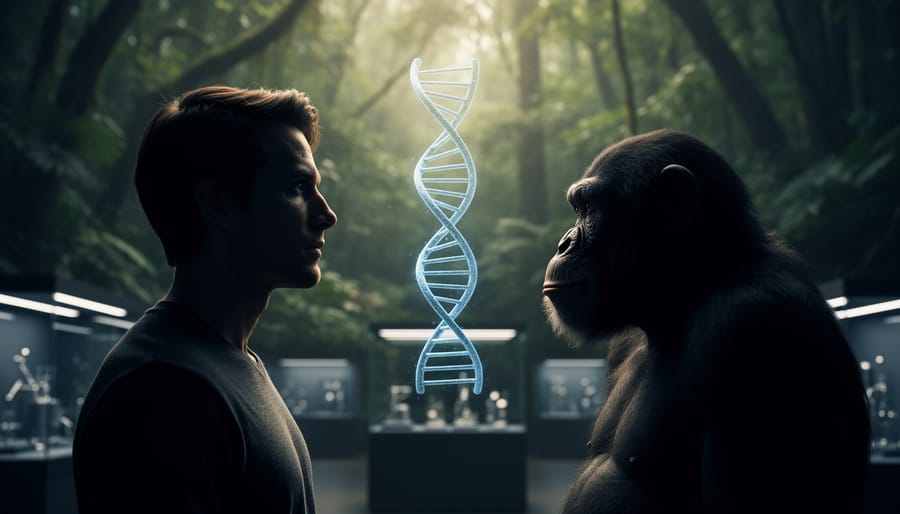
Humans share approximately 98.8% of their DNA with chimpanzees and bonobos, making these two great apes our closest living genetic relatives. This figure, often rounded to 99%, represents one of the most profound discoveries in modern biology, revealing that the genetic difference between you and a chimpanzee is smaller than the difference between many species that look far more similar to one another.
Understanding what this genetic similarity actually means requires looking beyond the headline number. When scientists say we share 98.8% of our DNA with chimps, they’re comparing protein-coding sequences and specific stretches of genome that can be directly aligned between species. The remaining 1.2% accounts for roughly 35 million DNA base pair differences, which sounds like a lot until you consider the human genome contains more than 3 billion base pairs total. Those small differences translate into significant changes in brain size, cognitive ability, skeletal structure, and the traits that make us distinctly human.
The discovery of our kinship with chimpanzees wasn’t immediate or obvious. Early anatomists suspected a connection based on skeletal similarities, but the genetic proof arrived only in the 1970s when DNA hybridization techniques first quantified the relationship. Since then, the complete sequencing of both human and chimpanzee genomes has refined our understanding, revealing not just which genes differ but how they differ in regulation, expression, and function.
This genetic closeness matters far beyond satisfying curiosity. It shapes medical research, conservation priorities, ethical frameworks for animal rights, and our fundamental understanding of what makes us human. The question isn’t just about percentages. It’s about what those percentages reveal about our evolutionary story and our place in the natural world.
What Genetic Closeness Actually Means
When scientists say humans share 98.8% of their DNA with chimpanzees, they’re describing something more nuanced than most people realize. Genetic closeness refers to the proportion of DNA sequences that are identical or nearly identical between two species when you line up their genomes side by side. Think of DNA as an instruction manual written in a four-letter alphabet (A, T, G, and C), and genetic similarity measures how many of those letters match up in the same order between species.
To understand what these percentages actually mean, it helps to know a few key terms:
- Genome
- The complete set of genetic instructions for building and operating an organism, contained in DNA. Humans have roughly 3 billion DNA base pairs in our genome.
- DNA Sequence Similarity
- The percentage of DNA letters (nucleotides) that match when comparing the same regions across two species’ genomes. This is what scientists measure when they say two species are “X% similar.”
- Homologous Genes
- Genes inherited from a common ancestor that perform similar functions in different species. These genes may have diverged slightly over millions of years but still serve related purposes.
- Genetic Distance
- A measure of evolutionary divergence between species based on accumulated genetic differences since they shared a common ancestor.
Here’s the crucial part: sharing 98.8% of our DNA with chimps doesn’t mean we’re 98.8% chimpanzee. Much of that shared DNA codes for basic cellular machinery that all animals need, instructions for making proteins, regulating metabolism, and building cells. A simple DNA model activity can demonstrate how small sequence changes create big differences.
The remaining 1-2% difference includes critical changes in gene regulation, expression timing, and quantity rather than just different genes altogether. Small tweaks in when and where genes activate during development can produce dramatically different outcomes, the difference between a human brain and a chimp brain, for instance. Additionally, percentage comparisons measure only DNA sequences that can be directly aligned; they don’t account for insertions, deletions, or structural rearrangements that also distinguish species.
How Scientists Measure Genetic Relationships
Before DNA sequencing became routine, scientists had to get creative. In the 1960s and 70s, researchers compared proteins between species, if two animals shared similar versions of hemoglobin or albumin, they were likely close relatives. Others used DNA hybridization, heating DNA strands until they separated, then mixing strands from different species to see how well they bonded back together. Stronger bonding meant more similar sequences, though the method gave only rough estimates.
The real breakthrough came with sequencing technology. By the 1980s, scientists could read actual genetic letters, the A, T, C, and G bases that make up DNA, and compare them directly between species. This was painstaking work at first, taking years to decode small gene segments. The Human Genome Project, completed in 2003, changed everything by mapping all 3 billion base pairs in human DNA. Once we had our own blueprint, comparing it to other species became exponentially faster.
Modern comparative genomics uses powerful computers to align entire genomes side by side, identifying matching sections and calculating similarity percentages. Scientists now employ several complementary techniques:
- DNA sequencing comparison, directly reading and matching genetic code between species
- Molecular clock analysis, using mutation rates to estimate when species diverged from common ancestors
- Chromosomal banding patterns, comparing the physical structure and arrangement of chromosomes
- Protein structure comparison, examining the functional molecules genes produce
- Phylogenetic tree construction, building evolutionary family trees from genetic data
The molecular clock deserves special mention. DNA mutates at roughly predictable rates over millions of years, acting like a genetic stopwatch. By counting differences between two species’ DNA and knowing the mutation rate, scientists estimate when their lineages split. This gives us not just relationships but timelines, we didn’t just learn that chimps are our closest cousins, but that we shared a common ancestor about 6-7 million years ago.
Subsequent projects sequencing chimpanzee, gorilla, orangutan, and bonobo genomes in the 2000s and 2010s let researchers make precise comparisons impossible a generation earlier. These weren’t simple intro to evolution exercises, they required coordinating data from multiple labs, developing new algorithms to handle billions of data points, and accounting for variations within species. The result? We can now pinpoint exactly which genes differ between humans and our relatives, and sometimes even explain what those differences do.
Our Closest Living Relatives: The Great Apes
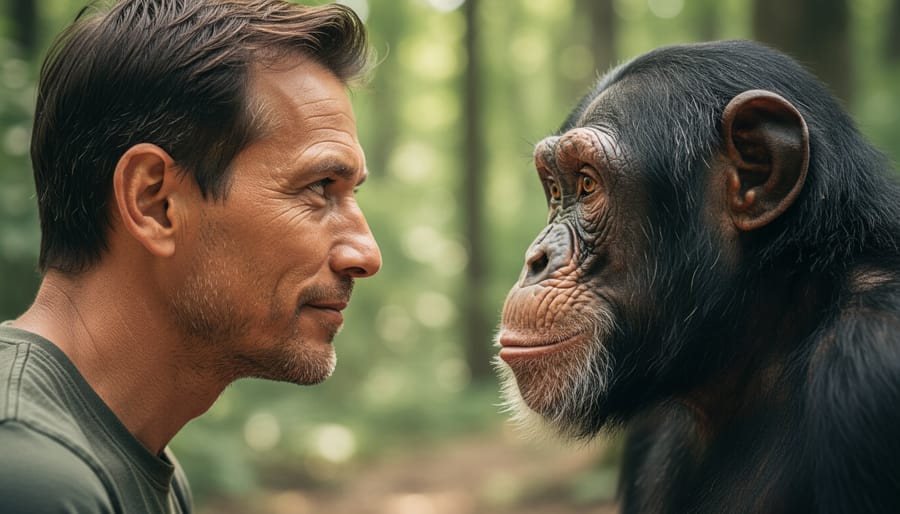
Chimpanzees and Bonobos: Our 98.8% Twins
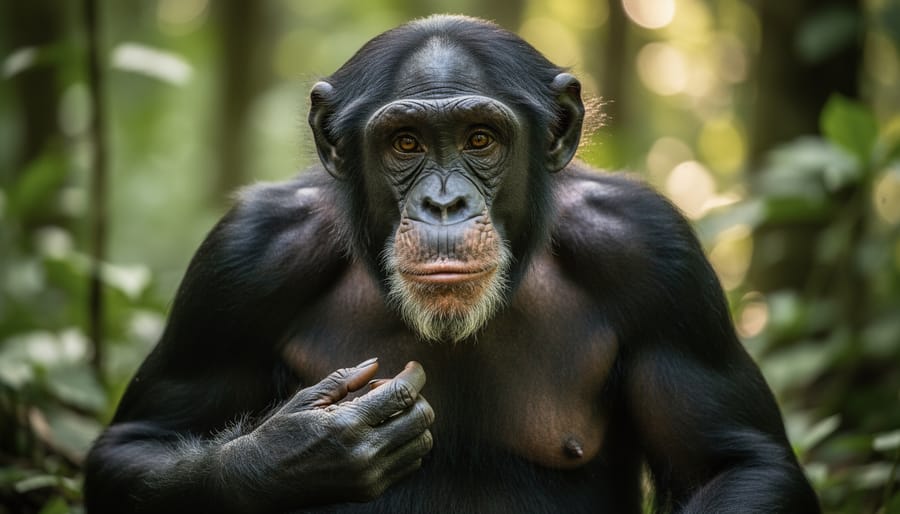
When scientists completed detailed comparisons of the bonobo, chimp, and human genomes they confirmed what decades of earlier research had suggested: these two species are our nearest living relatives. Both common chimpanzees (Pan troglodytes) and bonobos (Pan paniscus) share approximately 98.8% of their DNA with humans, a similarity so close that some researchers initially proposed reclassifying all three species under the same genus.
That remaining 1.2% difference, though small in percentage, translates to roughly 35 million individual nucleotide differences across our genome. These variations account for everything that makes us distinctly human: our upright posture, reduced body hair, larger brains, complex language abilities, and unique vocal anatomy. The same tiny fraction explains why chimps have longer arms relative to their legs, protruding jaws, and brains about one-third the size of ours.
What makes this genetic closeness particularly fascinating is how dramatically behavior can differ despite near-identical DNA. While chimp observations reveal hierarchical, sometimes aggressive social structures led by dominant males, bonobos organize themselves around female coalitions and resolve conflicts through social bonding rather than violence. Humans display elements of both patterns, suggesting our last common ancestor, which lived about 6 to 7 million years ago, passed down behavioral flexibility that all three species express differently.
The genes that differ most between us involve brain development, immune function, and reproduction. What appears as simple genetics in percentage terms actually represents profound evolutionary divergence, demonstrating how small genetic changes can produce dramatic functional differences when they affect key regulatory genes.
Gorillas, Orangutans, and the Wider Ape Family
While chimps and bonobos sit atop the genetic similarity leaderboard, the wider great ape family reveals equally fascinating connections. Gorillas occupy the next rung on our evolutionary tree, humans and gorillas share 98.3% of their DNA, making these massive primates closer relatives than many people realize. That mere 0.5% difference from chimps represents millions of years of divergent evolution, yet it’s still an astonishingly small genetic gap for animals that can weigh 400 pounds and live in completely different social structures.
Orangutans mark a more substantial evolutionary distance at roughly 97% genetic similarity. These great apes followed their own path when their ancestors left Africa for the rainforests of Borneo and Sumatra about 14 million years ago. Their solitary lifestyle and arboreal adaptations contrast sharply with African apes, yet nearly all their genes still function identically to ours.
These percentages tell a story of primate evolution radiating outward from common ancestors. Around 10 million years ago, the gorilla lineage split from the human-chimp line. About 14 million years before that, orangutans branched off. Each divergence point represents populations adapting to different environments, African forests versus Asian jungles, fruit-rich canopies versus ground-level vegetation, while retaining the core genetic machinery that defines us all as great apes. The DNA doesn’t lie: we’re a recent variation on an ancient theme.
Beyond the Obvious: Unexpected Genetic Connections
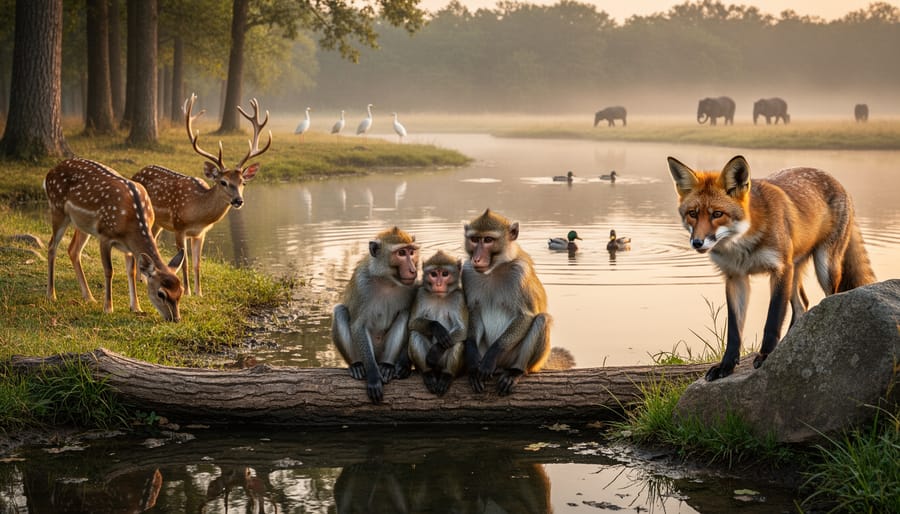
The family tree of life reveals something extraordinary: you share roughly 90% of your DNA with house cats and laboratory mice. These aren’t our closest relatives by any stretch, yet the genetic overlap is stunningly high. Dogs clock in at about 85%, despite diverging from our lineage tens of millions of years earlier than the great apes. The numbers get even more surprising as we move further out. Chickens share approximately 60% of our genetic blueprint. Fruit flies, those tiny insects buzzing around overripe bananas, also sit at around 60% similarity.
These percentages don’t mean a chicken is 60% human or that we’re part mouse. They reflect something more fundamental about how life works at the molecular level. When scientists compare genomes across species, they’re measuring how many genes perform similar functions, how DNA sequences align, and which genetic instructions have remained stable across hundreds of millions of years of evolution. The genes conserved between fly and human aren’t random overlap. They’re the core genetic toolkit that all complex life requires: genes that regulate cell division, build proteins, repair damaged DNA, and coordinate basic metabolism.
Think of it like computer code. Different programs might look completely different on screen, but under the hood they share fundamental operations: loops, conditional statements, data storage. Similarly, whether you’re building a human, a mouse, or a fruit fly, you need genes to control how cells grow, when they divide, and how they respond to their environment. Natural selection ruthlessly preserves what works. A gene that successfully regulates cell growth in an ancient common ancestor gets passed down, tweaked slightly over millions of years but never entirely rewritten. That’s why a diabetic patient might receive insulin originally studied in mice, why cancer researchers study tumor suppression in fruit flies, and why evolutionary biologists can trace disease vulnerabilities back through our shared genetic heritage with creatures that look nothing like us.
Why These Genetic Connections Matter
Understanding why we’re genetically similar to other animals isn’t merely an academic curiosity, it transforms how we develop medicines, study diseases, and comprehend our own biology. The genetic kinship between humans and other species has become the foundation of modern biomedical research and evolutionary medicine.
Mouse models have become the workhorses of medical research precisely because we share about 90% of our genes with these small rodents. When scientists want to understand how a disease progresses or test a potential treatment, they often create mice with the same genetic mutation that causes the condition in humans. Because our fundamental cellular machinery works so similarly, a drug that affects a particular protein pathway in a mouse will likely affect the same pathway in humans. This genetic overlap explains why hundreds of treatments, from cancer therapies to diabetes medications, were first validated in mouse studies before reaching human trials.
The practical applications of human-animal genetic connections extend across multiple fields:
- Disease modeling in laboratory mice allows researchers to study conditions like Alzheimer’s, diabetes, and cancer in controlled settings
- Drug testing protocols rely on shared genetic pathways to predict human responses and identify toxic effects early
- Evolutionary insights reveal why humans remain vulnerable to certain diseases that our genetic cousins handle differently
- Primate conservation efforts gain urgency when we recognize that protecting chimps and bonobos means preserving our closest genetic relatives
- Understanding human uniqueness becomes possible only by identifying which genes differ from our primate cousins and what those differences accomplish
Studying primate genomes has revealed human-specific vulnerabilities and strengths. Researchers comparing human DNA to chimpanzee DNA have identified genes associated with brain size, language development, and susceptibility to diseases like HIV and malaria. Some pathogens that devastate human populations barely affect our closest relatives, and understanding why requires examining the genetic differences in immune system genes.
Conservation takes on new meaning when we recognize that allowing great apes to go extinct means losing species that could teach us about human diseases, aging, and cognition. A chimpanzee population harbors genetic variations that might hold clues to treating human neurological disorders, making each wild population scientifically invaluable.
These genetic connections remind us that medical breakthroughs don’t happen in isolation, they emerge from understanding the shared evolutionary heritage written into every living thing’s DNA.
Types of What Animal Are Humans Genetically Closest to
When exploring our genetic connections to other animals, these relationships fall into distinct categories based on evolutionary distance and the degree of DNA similarity.
Close Primate Relatives (98-99% similarity) represent our immediate family on the evolutionary tree. This tier includes chimpanzees, bonobos, and gorillas, species that diverged from our lineage relatively recently in evolutionary terms. These relationships provide the clearest windows into recent human evolution and traits unique to our lineage.
Distant Primate Cousins (93-97% similarity) encompass orangutans, gibbons, and Old World monkeys. While still primates, these species separated from our ancestors further back, making them valuable for understanding broader primate characteristics rather than human-specific features.
Mammalian Relatives (80-90% similarity) include mice, rats, cats, and dogs. These connections might surprise readers, but they reflect our shared mammalian heritage. Laboratory mice serve as research models precisely because this genetic overlap makes them useful proxies for studying human biology and disease.
Vertebrate Connections (60-85% similarity) extend to chickens, fish, and reptiles. This tier reveals fundamental biological machinery, basic cellular functions and developmental processes, that evolved hundreds of millions of years ago.
These categories demonstrate how genetic similarity decreases with evolutionary distance, yet even distant relatives provide science inspiration for understanding the core mechanisms that make life possible.
Common Questions About Human-Animal Genetic Similarity
The gap between 98.8% genetic similarity and the vast differences we see between humans and chimpanzees puzzles most people encountering these numbers for the first time. That small percentage represents millions of base pairs, around 35 million differences, that cascade into profound effects on development, brain structure, and capabilities. Even a single gene switching on at a different time during embryonic development can reshape an entire organism.
Did humans evolve from chimpanzees?
No. Humans and chimpanzees both evolved from a common ancestor that lived roughly 6-7 million years ago, then diverged down separate evolutionary paths. Neither species is the parent of the other.
Why do small genetic differences create such different animals?
The placement and timing of gene expression matter enormously. A 1.2% difference affects regulatory genes that control when and how other genes activate during development, which multiplies into major differences in brain size, skeletal structure, and behavior.
What genes make humans unique?
Key differences cluster around brain development genes like FOXP2 (linked to speech), HAR1 (influencing cortex formation), and genes controlling the timing of brain growth. We also have unique changes in genes affecting hand dexterity and bipedal walking.
Can we interbreed with genetically close species?
No. Despite high genetic similarity, humans and chimpanzees have different numbers of chromosomes (46 vs. 48), and millions of years of separate evolution have created reproductive incompatibility at the cellular level.
The question of what makes humans special despite sharing most of our genome with other animals cuts to the heart of how evolution works. Genetic similarity doesn’t predict intelligence, culture, or complexity in a straightforward way. Octopuses possess remarkable problem-solving abilities yet share far less DNA with us than mice do. What matters isn’t just which genes you have, nearly all animals share the same basic toolkit, but how those genes are regulated, which versions you carry, and how they interact during the critical windows of development when bodies and brains take shape.
The evidence is clear: we share 98.8% of our DNA with chimpanzees and bonobos, making them our closest living relatives. But this remarkable similarity is just one thread in a much larger tapestry. We carry 98.3% similarity to gorillas, 97% to orangutans, and surprisingly substantial genetic overlap with creatures as diverse as mice, chickens, and even fruit flies. These aren’t just numbers, they’re proof of our deep connection to all life on Earth, written in the very molecules that make us who we are.
Understanding these genetic relationships transforms both science and philosophy. Medically, it explains why mouse models can predict human disease responses and why studying primate genomes reveals our vulnerabilities to cancer and heart disease. Evolutionarily, it maps our journey from ancient common ancestors to modern humans. But perhaps most importantly, recognizing these human-animal ties challenges the notion that we’re separate from nature.
We’re not outside the natural world looking in, we’re part of an unbroken chain of life stretching back billions of years. That 1.2% difference from chimps gave us language, abstract thought, and the ability to decode our own genome. Yet the 98.8% we share reminds us that we’re kin to every living thing, connected by the same evolutionary story written in DNA.