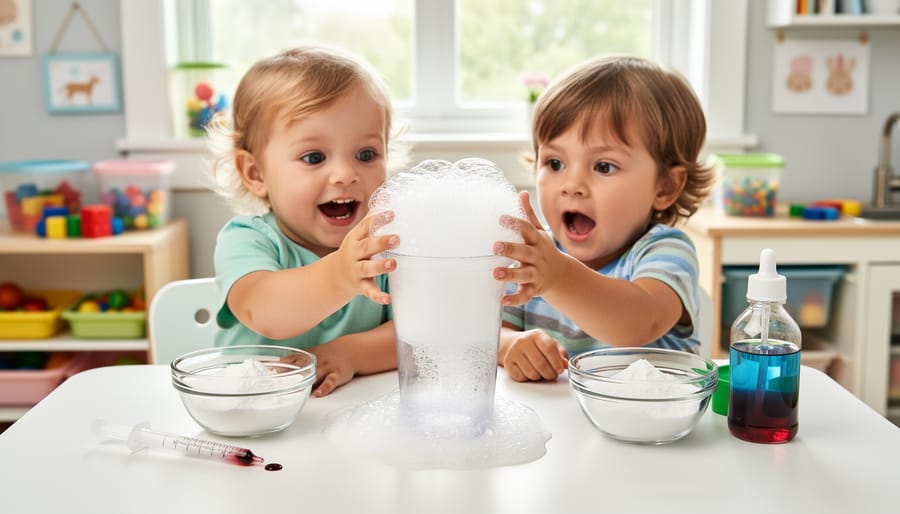
Preschool science experiments turn everyday household items into powerful learning tools that spark curiosity and build critical thinking in children aged three to five. You need nothing more than baking soda, vinegar, food coloring, water, and a few containers to demonstrate cause-and-effect, observation skills, and basic scientific method through hands-on exploration that takes five to fifteen minutes per activity.
The magic lies in simplicity. When a child watches a volcano of foam erupt from mixed vinegar and baking soda, or observes how oil refuses to blend with colored water, they’re not just entertained. They’re learning to predict outcomes, test hypotheses, and articulate what they see. These aren’t watered-down versions of real science. They’re authentic investigations scaled to tiny hands and developing minds.
Parents and educators searching for easy preschool science experiments share a common challenge: bridging the gap between scientific concepts and the attention span of a four-year-old. The solution rests in choosing experiments that deliver immediate, visible results while requiring minimal setup and zero specialized equipment. Cost-effective activities drawing on common household items become the key ingredients for success, transforming kitchen tables into laboratories where young scientists can safely explore under supervision.
The experiments that follow require no scientific background from you. Each activity includes clear material lists, safety guidance, step-by-step instructions, and simple ways to verify learning happened. More importantly, they invite conversation. Science for preschoolers thrives not in silent observation but in the questions asked, the predictions made, and the wonder expressed when something unexpected unfolds before curious eyes. That dialogue during the activity matters as much as the experiment itself.
Why Science Experiments Matter for the Youngest Minds
The window of preschool years, roughly ages two to five, offers a singular opportunity. Children at this stage possess an uninhibited willingness to question, touch, and test the world around them. Every puddle becomes a laboratory, every shadow a puzzle waiting to be solved. When we channel this natural curiosity through structured yet playful experiments, we’re not simply entertaining young minds, we’re building the neural pathways that underpin logical reasoning, pattern recognition, and adaptive thinking.
Simple experiments introduce preschoolers to STEM concepts in ways that formal schooling cannot replicate. A three-year-old watching ice melt isn’t memorizing facts about states of matter; she’s witnessing transformation firsthand, forming questions, making predictions about what might happen next. These activities boost critical thinking, problem-solving, and creativity precisely because they invite children to engage with phenomena rather than passively receive information. The child who asks “Why did the raisins dance?” after seeing them rise and fall in carbonated water has entered the doorway of scientific inquiry.
The blend of fact and wonder matters deeply here. We’re not stripping away imagination to impose rigid methodology. Instead, we’re honoring the way young children naturally learn: through exploration, repetition, and the thrill of discovery. When a preschooler mixes two liquids and sees foam erupt, the line between magic and science blurs in the most productive way. That sense of awe, the gasp, the wide eyes, the insistence on “doing it again”, signals genuine engagement. It plants seeds of confidence that science isn’t something distant or intimidating, but a language they can speak fluently even before they read their first word.
What You’ll Need: Simple Materials from Your Kitchen and Beyond
You don’t need a laboratory or a budget to turn your home into a place of discovery. The most compelling preschool science experiments draw on items already sitting in your pantry, your recycling bin, and your backyard. This cost-effective approach transforms the familiar into the extraordinary, inviting toddlers to see ordinary objects through fresh eyes. A bottle of vinegar becomes a catalyst for volcanic eruptions. A handful of ice cubes tells the story of melting and heat. Food coloring unlocks the secrets of how colors blend and dance. When everyday materials double as scientific tools, you’re not just teaching concepts, you’re showing children that wonder lives everywhere, waiting to be noticed.
Start by gathering a few staples that appear in nearly every preschool experiment:
- Baking soda and white vinegar for chemical reactions
- Food coloring in primary colors for mixing and observation
- Clear containers, jars, and bowls to watch processes unfold
- Water in various temperatures for exploring states of matter
- Household objects like spoons, funnels, and measuring cups
- Natural items such as rocks, leaves, flowers, and pinecones
- Ice cubes, salt, and sugar for transformation experiments
- Carbonated water or soda for buoyancy activities
Each item carries its own narrative potential. A clear jar isn’t just a container; it’s a window into invisible forces. A leaf plucked from the garden becomes evidence of texture, color variation, and seasonal change. Even a simple measuring cup teaches volume, pouring precision, and the satisfying ritual of careful preparation.
The beauty of this material list is its flexibility. You don’t need everything at once, and you don’t need specialized versions. Generic white vinegar works exactly as well as any branded alternative. Recycled yogurt containers serve as observation vessels just as effectively as purchased lab equipment. Nature provides an endless supply of free materials, twigs, pebbles, petals, feathers, that invite sensory exploration and comparison.
Keep your supplies in a dedicated basket or drawer, ready for spontaneous experiments when curiosity strikes. This accessibility turns science into a daily rhythm rather than a special occasion, honoring the toddler’s natural impulse to ask why, to touch, and to test the world around them.
Safety First: Supervising Young Explorers
Preschool science experiments are perfectly safe under supervision, but toddlers explore the world with their hands, mouths, and boundless curiosity. Your primary task is to create a controlled environment where discovery can flourish without risk. Start by scanning every material you plan to use through the lens of a toddler’s unpredictability. Baking soda, vinegar, water, food coloring, and most kitchen staples pose minimal danger, but beads, small objects, and anything that could lodge in a windpipe must be kept out of reach or omitted entirely. Always choose non-toxic materials and check labels before introducing anything new. If you wouldn’t want it in a mouth, it doesn’t belong in a preschool experiment.
Demonstrate each step yourself before inviting participation. Young children learn by watching, and your calm, methodical approach models both the process and the boundaries. Set clear expectations: we pour gently, we watch the bubbles, we keep materials on the tray. These verbal cues transform chaotic exploration into structured inquiry. Choose a contained space like a kitchen table or outdoor patio where spills won’t cause alarm. Lay down towels, use trays with edges, and embrace the mess as part of the learning process rather than a disruption to manage. The goal is not perfection but safe, joyful discovery.
Keep experiments short and simple, ending before attention wanes and impulse control dissolves. A supervised five-minute volcano eruption teaches more than a twenty-minute free-for-all. Your presence isn’t just oversight; it’s the scaffolding that turns random play into meaningful science.
The Four-Step Dance: How to Run Each Experiment
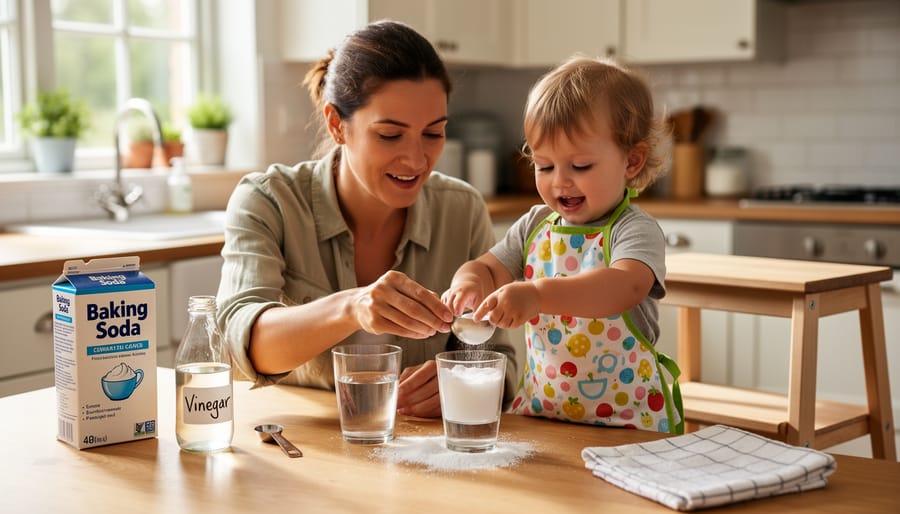
Prediction: Planting Seeds of Hypothesis
Before your child drops that ice cube into the water or watches the raisins plunge into fizzy soda, pause for a moment of possibility. Ask what they think will happen. This simple question plants the seed of hypothesis formation, the foundation of scientific thinking. You don’t need scientific vocabulary or the phrase “let’s hypothesize”, just invite curiosity. “Will the ice sink or float? What do you think?” Let them point, gesture, or offer their toddler logic. There’s no wrong answer here, only the beginning of observation and reasoning. Some children will guess confidently; others might shrug or simply stare with wide eyes. Both responses are valid. The act of considering an outcome before it happens teaches prediction, a skill central to hands-on activity safety protocols and scientific exploration alike. Honor whatever they offer, a giggle, a wild guess, silence, and then move forward into discovery together.
Discussion: Where the Real Learning Lives
The true magic of preschool science unfolds in conversation. When a child watches vinegar bubble into baking soda, the immediate spectacle captivates them, but the deeper learning arrives through your questions and their answers. Ask what they see, hear, or smell. Wonder aloud why the foam climbs the sides of the container. Let them narrate the transformation in their own words, however jumbled or poetic. Research confirms that young children develop critical language through science talk during hands-on exploration, building vocabulary and conceptual bridges that textbooks cannot touch. This back-and-forth turns a fleeting reaction into a story they own, embedding observation skills and causal reasoning. The mess fades, but the conversation lingers, shaping how they approach the next experiment and the world beyond the kitchen table.
Five Easy Experiments to Start Your Journey
The Erupting Volcano: Baking Soda and Vinegar Magic
Picture a miniature mountain crafted from playdough or molded sand, hollowed at the peak to cradle a small container. Pour in two tablespoons of baking soda, add a few drops of red food coloring for molten drama, then let your preschooler slowly tip in a quarter cup of vinegar. The eruption is instant: foam surges over the rim, spilling down the slopes in a fizzing cascade that delights every time.
This classic reaction demonstrates cause-and-effect in vivid, tangible form. The vinegar (an acid) meets the baking soda (a base), producing carbon dioxide gas that creates the bubbles and overflow. For a toddler, the spectacle is pure magic, something inert transforms into motion and sound. Ask them what they see, what they hear, even what they smell. Let them repeat the experiment, varying the amounts or the speed of pouring. Each eruption reinforces the idea that actions have predictable, observable consequences, a cornerstone of scientific thinking wrapped in the thrill of a bubbling, hissing volcano.
Dancing Raisins: The Mystery of Buoyancy
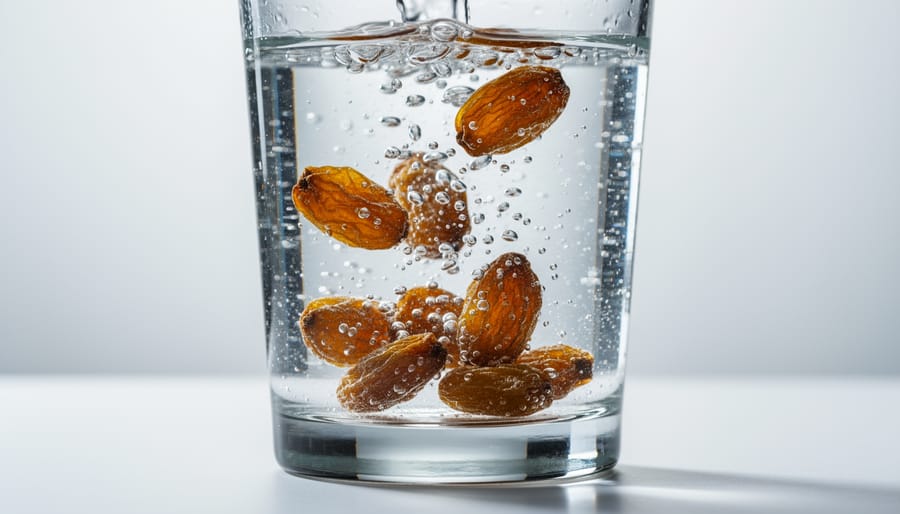
Imagine a handful of ordinary raisins suddenly springing to life, bobbing up and down in a glass of clear, fizzing water like tiny dancers on an invisible stage. This experiment never fails to captivate preschoolers because it transforms something familiar into something magical.
You’ll need a clear glass or jar, carbonated water (sparkling water or club soda works beautifully), and a small handful of raisins. Pour the carbonated water into the glass, then drop in the raisins one by one while your young scientist watches closely. Ask them what they think will happen before the raisins hit the water.
The raisins will initially sink to the bottom because they’re denser than water. But here’s where the wonder begins: carbon dioxide bubbles in the water cling to the wrinkled surface of each raisin, creating tiny life vests that lift them toward the surface. When the raisins reach the top, the bubbles pop and escape into the air, and down the raisins tumble again, only to collect more bubbles and rise once more. This dance continues until the water loses its fizz, giving you several minutes of mesmerizing observation and delighted questions about why the raisins won’t stay still.
Color Mixing Revelations: Water and Food Coloring
Fill three clear glasses with water and set them before your toddler like tiny laboratories waiting to be transformed. Add a single drop of food coloring to each, red, yellow, blue, and watch her eyes widen as color blooms through the liquid like silent fireworks. This is observation at its purest: cause meets effect in real time, and the world reveals one of its secrets.
Now comes the revelation. Pour half the red water into the yellow, and let your child predict what will happen before the colors swirl together into orange. The transformation isn’t just visual, it’s conceptual. She’s witnessing something new born from two familiar things, learning that the world can be remade through simple combination.
Try blue and yellow next, then red and blue. Each mixture offers a fresh surprise, a small proof that reality follows patterns she can discover herself. Encourage her to name the new colors, to describe how the blending happens, to wonder aloud whether other combinations might work. This experiment requires no heat, no fizzing chemicals, just water and dye, yet it teaches color theory, prediction, and the fundamental scientific truth that observation changes everything we think we know.
Ice Melt Races: Temperature and States of Matter
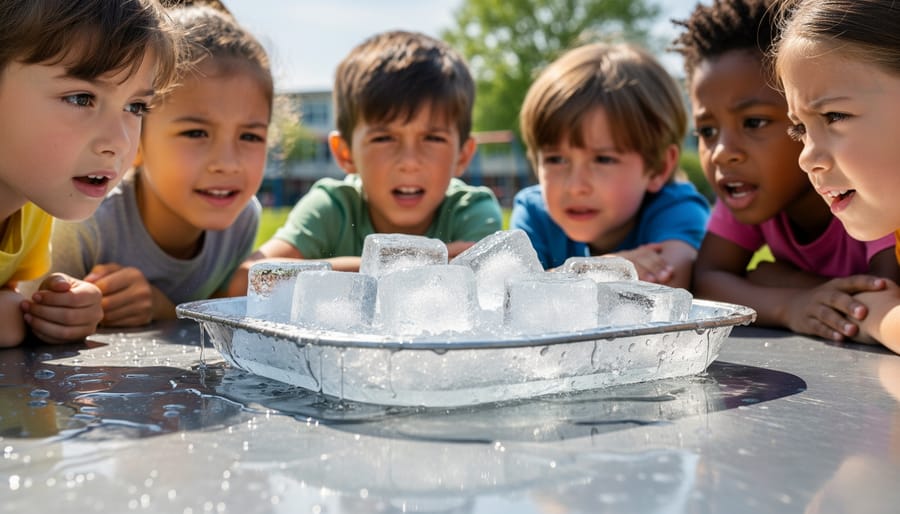
Picture two ice cubes side by side, one resting in a shallow dish at room temperature, the other nestled in a bowl of warm water. Ask your preschooler which will vanish first. This simple setup transforms a kitchen counter into a laboratory, revealing how heat travels and how matter shifts from solid to liquid. The child watches, transfixed, as one cube shrinks slowly while the other surrenders in moments, bubbles rising from its edges like tiny whispers of transformation.
The magic lies in comparison. Place ice cubes in different conditions: one in sunlight streaming through a window, another in shade, a third wrapped in a kitchen towel. Your toddler predicts, observes the changing shapes, touches the cool puddles forming beneath. The experiment teaches temperature’s invisible hand at work, a concept as fundamental as understanding how plants and science connect through observation and inquiry. With discussion during the activity, children build vocabulary around melting, freezing, and warmth, linking everyday sensations to scientific principles that govern their world.
Sink or Float: Predicting Density
Gather a collection of small household objects, a wooden block, a metal spoon, a plastic toy, a grape, a cork, a rock, and fill a clear container with water. Before each object goes in, ask your child to predict: will it sink or float? Let them voice their guess and reasoning, no matter how fanciful. Then, one by one, release the objects gently into the water and watch together. Some will plummet to the bottom; others will bob on the surface. The surprise and delight when predictions prove wrong are where real learning lives.
This simple experiment introduces the concept of density without naming it. Heavy objects that sink, light ones that float, these observations plant seeds of understanding about mass, volume, and how materials behave in water. Repeat the experiment with different items, encouraging your child to sort objects into “sinkers” and “floaters” before testing. The hands-on sorting, predicting, and observing build critical thinking and problem-solving skills while keeping the experience playful and immediate. No complex setup, just water and curiosity.
How to Know Your Experiment Worked: Verification and Next Steps
The magic of preschool science isn’t in perfect execution or memorized facts, it’s in the spark you see when a child leans closer, asks “why did that happen?”, or wants to try the same experiment again tomorrow. Success shows up in engagement, not outcomes.
Watch for these signs that learning has taken root:
- The child asks to repeat the experiment or suggests variations (“What if we use more vinegar?”)
- They talk about what they observed using new vocabulary, even if imperfectly
- They connect the experiment to something else in their world (“The bubbles are like my bath!”)
- They show the experiment to a friend, parent, or sibling with excitement
- They revisit the materials during free play, recreating steps on their own
You won’t see mastery of scientific concepts, that’s not the goal. Instead, look for curiosity sustained beyond the activity itself. A toddler who runs to show you a melting ice cube outside or who dumps water into different containers to see what floats has internalized the spirit of inquiry.
Extend the learning by layering related experiences. After a color-mixing experiment, offer watercolor paints or take a nature walk to identify different hues. Follow a sink-or-float activity with bathtime exploration or a trip to a pond. Introduce picture books that celebrate observation and discovery, or explore science-inspired fiction that blends wonder with real-world principles.
Build a rhythm by designating one afternoon a week as “experiment time,” but stay flexible. The richest learning often happens when a child’s spontaneous question, “Why is the sky blue?” or “Where does rain come from?”, becomes the launchpad for hands-on discovery. Keep a small bin of basic materials accessible so you can pivot to exploration whenever curiosity strikes.
The real verification isn’t a checklist. It’s the moment your preschooler tugs your sleeve and says, “Let’s try something.”
Common Questions About Preschool Science Experiments
What age is best to start science experiments with young children?
You can begin simple hands-on explorations as early as 18 months, though most preschool science activities are designed for children ages two to five. The key is matching the complexity to your child’s attention span and motor skills, starting with sensory-based observations before moving to multi-step processes.
How often should I do science experiments with preschoolers?
There’s no magic number, but consistency matters more than frequency. Even one experiment per week builds scientific thinking habits, while daily micro-experiments during routines like cooking or bath time can naturally weave discovery into everyday life.
How do I manage the inevitable mess?
Embrace it as part of the learning process. Set up experiments in easy-to-clean spaces like kitchens or outdoor areas, use trays to contain spills, and involve children in cleanup as an extension of the activity. The mess is temporary; the curiosity and predictions you nurture last far longer.
Can I adapt experiments for children at different developmental stages?
Absolutely. Younger toddlers might simply observe color mixing, while four-year-olds can predict outcomes and explain what they see. Adjust your vocabulary, the number of steps, and your expectations based on each child’s readiness, always keeping the focus on hands-on exploration rather than getting the “right” answer.
The beauty of preschool science lies in its flexibility. You don’t need a laboratory or a teaching degree to guide young explorers through these moments of discovery. What you do need is patience, a willingness to follow their questions wherever they lead, and the understanding that a spilled cup of colored water might teach more about cause-and-effect than a perfectly executed demonstration. These cost-effective activities draw on common household items as the key ingredients, making science accessible in any setting.
Many parents wonder if they should follow a curriculum or stick to spontaneous exploration. The answer lives somewhere in between. Having a handful of go-to experiments ready gives you structure when you need it, but the most powerful learning often happens when you pause mid-breakfast to investigate why cereal floats or stop during a walk to examine ice forming on a puddle. The experiments should come with lots of discussion during the activity, transforming simple observations into rich conversations that build vocabulary and critical thinking simultaneously.
Easy preschool science experiments are not merely activities to fill an afternoon, they are invitations into a lifelong conversation with the world. Each baking soda volcano, each melting ice cube, each raisin dancing in carbonated water plants a seed of wonder that can bloom for decades. The mess on the counter, the sticky fingers, the endless “why” questions, these are not obstacles to endure but evidence that a young mind is learning to observe like a scientist to question assumptions, to find magic in the mechanics of everyday life.
The blend of fact and imagination is where true understanding lives. When you guide a toddler through these simple experiments, you’re not just teaching cause and effect; you’re honoring their natural genius for discovery. Embrace the unpredictable delight, the spills, the surprises. Science at this age is as much about the story you tell together as the principles you demonstrate. Every question answered opens ten more doors, and that’s exactly as it should be. Keep exploring, keep wondering, and let curiosity lead the way.