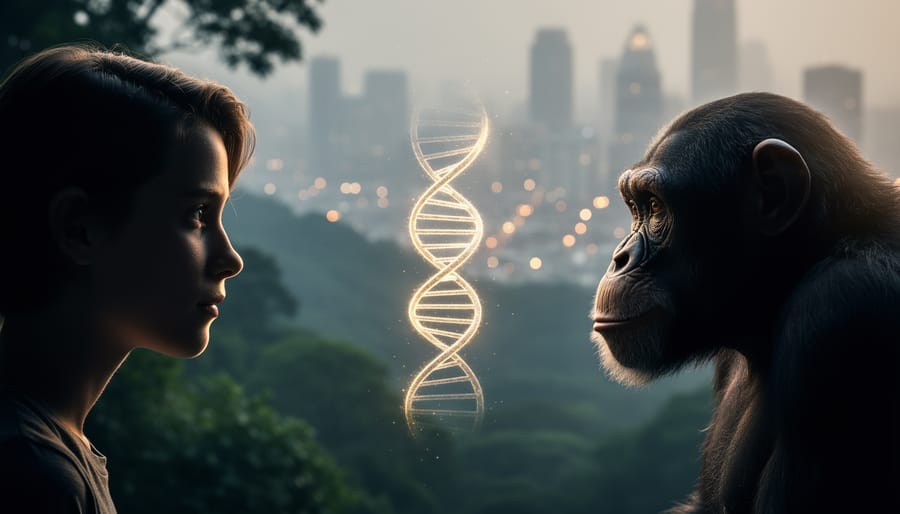
Humans are genetically closest to chimpanzees and bonobos, sharing approximately 98.8% of our DNA with these great apes. This near-identical genetic overlap means that the biological distance between you and a chimpanzee is smaller than the distance between a horse and a zebra, or even between some species of mice.
But what does genetic closeness actually mean, and why does a difference of just over 1% translate into such dramatic distinctions between humans swinging briefcases and chimpanzees swinging through trees? The answer lies not just in counting matching DNA letters, but in understanding how genes are organized, expressed, and regulated. That small percentage difference encompasses thousands of individual genetic changes, some of which have profound effects on brain development, language capacity, and bipedal locomotion.
The quest to map our genetic kinship with other species has transformed from anatomical speculation into precise molecular science. Where 19th-century naturalists could only guess at evolutionary relationships by comparing bones and behaviors, today’s geneticists can pinpoint the exact mutations that separate us from our closest living relatives. These measurements reveal a primate family tree where humans, chimpanzees, and bonobos form a tight cluster, with gorillas as slightly more distant cousins and orangutans further out still.
Understanding our genetic proximity to other animals carries weight beyond satisfying curiosity. It informs medical research, as chimpanzees and other primates serve as models for human diseases. It shapes conservation priorities, highlighting our ethical responsibilities toward species that are, in molecular terms, our near-twins. And it provides a humbling perspective on human uniqueness: we are simultaneously exceptional in our cognitive abilities and unremarkable in our genetic makeup, separated from our closest relatives by evolutionary moments rather than chasms.
This exploration will decode what genetic similarity actually measures, reveal the specific percentages that connect us to various species, and examine why those numbers matter far beyond the laboratory.
What Genetic Closeness Actually Means
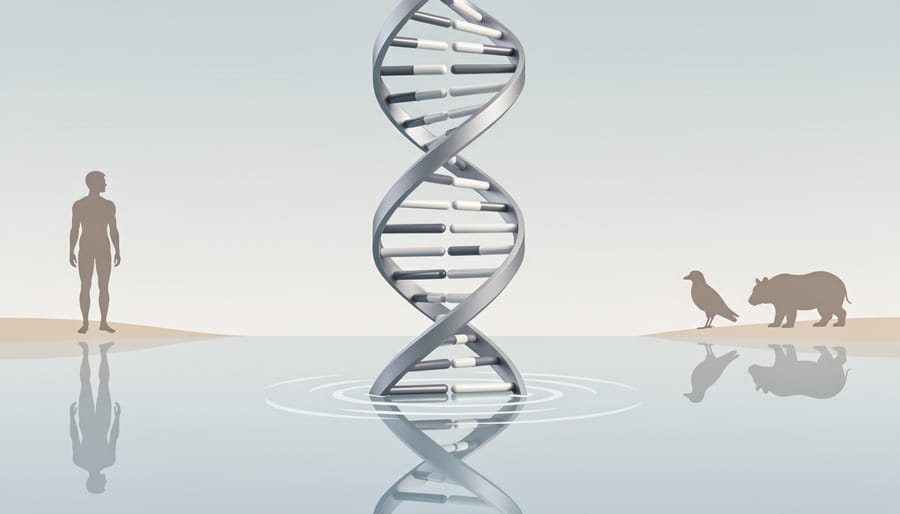
When scientists say two species are “98.8% genetically similar,” they’re comparing the actual letters in our DNA instruction manuals. Your genome contains roughly 3 billion base pairs, those are the chemical units (adenine, thymine, guanine, and cytosine) that pair up to form the rungs of DNA’s twisted ladder. When researchers compare human DNA to chimpanzee DNA, they line up these sequences side-by-side and count how many letters match.
But here’s where it gets interesting. That percentage doesn’t tell the whole story. Scientists distinguish between different types of genetic similarity: shared sequences (matching letter-for-letter stretches), shared genes (instructions for building proteins that exist in both species), and functional similarities (genes that do the same job, even if the exact sequence varies slightly). A 98% match means that if you randomly picked 100 base pairs from a human genome and compared them to the corresponding spot in a chimp genome, 98 would be identical.
- DNA Sequencing
- The process of determining the exact order of base pairs in a DNA molecule, creating a readable map of genetic instructions. Modern techniques can decode billions of base pairs rapidly, making species comparisons possible.
- Base Pairs
- The fundamental units of DNA composed of two chemical bases that bond together, adenine with thymine, and guanine with cytosine. These pairs form the rungs of DNA’s ladder-like structure.
- Genome Mapping
- The complete identification and arrangement of all genes and genetic material in an organism. A finished genome map serves as the reference point for comparing different species.
- Genetic Divergence
- The accumulation of genetic differences between species over time as they evolve separately. The degree of divergence indicates how long ago two species shared a common ancestor.
- Common Ancestor
- The most recent species from which two different organisms descended. Humans and chimpanzees shared a common ancestor roughly six to seven million years ago.
The paradox is this: seemingly tiny genetic differences create enormous biological consequences. That 1.2% difference between humans and chimps encompasses changes in brain development genes, vocal anatomy, and hairlessness. Think of DNA like computer code. Changing just a few lines in critical sections can make software behave completely differently, while thousands of changes in non-essential code might barely affect performance. Evolution works the same way, some genetic differences sit in crucial control regions that regulate how hundreds of other genes behave, creating cascading effects throughout development.
How Scientists Compare Our DNA to Other Species
Comparing human DNA to that of other species requires a sophisticated set of laboratory techniques and computational tools that have evolved dramatically over the past few decades. The foundation was laid by the Human Genome Project, which between 1990 and 2003 mapped all three billion base pairs in our genetic code. This massive international effort created the reference genome that researchers now use as a baseline for comparison, but the real breakthroughs came afterward when similar mapping efforts extended to chimpanzees, gorillas, mice, and hundreds of other species.
The process begins with sample collection. Scientists obtain tissue samples from living animals through non-invasive methods like cheek swabs or blood draws, though sometimes they work with preserved specimens from museum collections or research facilities. Once collected, DNA extraction isolates the genetic material from cells, breaking down cellular membranes and proteins to leave behind the pure double helix structure.
Modern genome sequencing has become remarkably efficient compared to the original Human Genome Project, which cost nearly three billion dollars and took over a decade. Today’s next-generation sequencing machines can decode an entire genome in days for a few thousand dollars. These devices fragment the DNA into millions of small pieces, read each fragment’s sequence of nucleotides (the A, T, C, and G building blocks), and generate massive datasets representing the complete genetic code.
The real magic happens during computational analysis. Researchers use powerful algorithms to:
- Collect biological samples from target species through blood draws, tissue biopsies, or preserved specimens
- Extract and purify DNA using chemical processes that separate genetic material from other cellular components
- Sequence entire genomes using high-throughput technologies that read millions of DNA fragments simultaneously
- Align corresponding genes and sequences between species using pattern-matching algorithms that identify matching regions
- Calculate statistical similarity by comparing base-pair matches, insertions, deletions, and structural variations across genomes
Alignment algorithms examine sequences from different species side-by-side, hunting for regions where the genetic code matches. A computer might scan through millions of base pairs, looking for stretches where human chromosome 2 lines up with chimpanzee chromosomes 12 and 13, for instance. The software accounts for mutations, insertions where extra genetic material appeared over evolutionary time, and deletions where sequences were lost.
What makes this comparison meaningful is that scientists don’t just count matching letters. They analyze functional genes, regulatory regions that control when genes activate, and structural variations. A 98.8% similarity with chimpanzees means that if you randomly selected a spot in human DNA and checked the corresponding location in chimp DNA, nearly 99 times out of 100, you’d find the same nucleotide. The remaining differences might seem tiny, but they represent millions of individual changes that accumulated over six million years of separate evolution.
Our Closest Genetic Relatives: The Primate Family Tree
Chimpanzees and Bonobos: Our Closest Living Kin
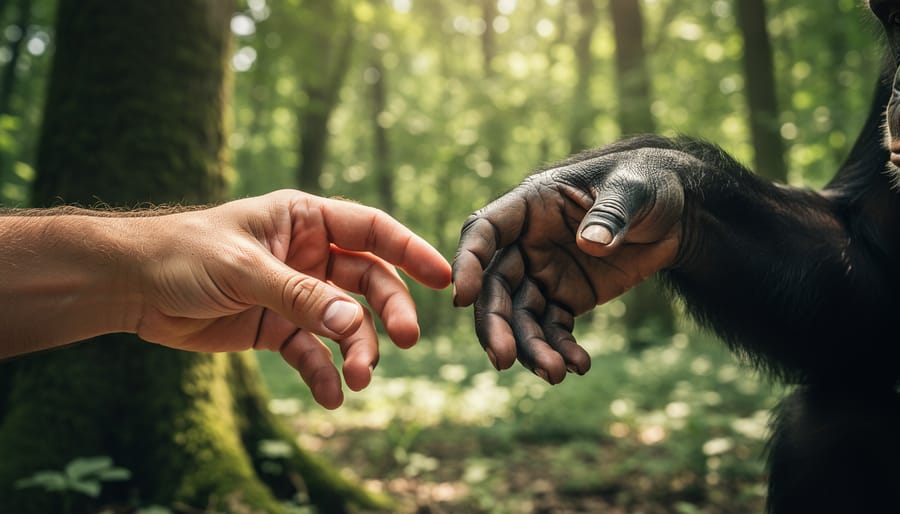
When you share 98.8% of your genetic code with another species, you’d expect them to look remarkably familiar. Stand before a chimpanzee at the zoo and you’ll see why: the expressive eyes, the grasping hands, the uncanny facial gestures that mirror our own emotions. This extraordinary genetic similarity stems from our shared ancestor who lived roughly six million years ago, just yesterday in evolutionary terms.
But what about that remaining 1.2% difference? Those roughly 35 million base pairs control critical features that separate us: the genes governing brain size and organization, vocal anatomy for complex speech, and bipedal skeletal structure. Think of it as the difference between similar software running on modified hardware. The genetic instructions for building proteins, regulating cell function, and maintaining basic biology remain nearly identical, yet subtle changes in gene regulation and expression create two distinctly different species.
Bonobos, often called pygmy chimpanzees, share this same genetic proximity to humans. Scientists once thought they were simply a chimpanzee subspecies until DNA analysis in the 1980s revealed them as a separate species, equally close to us genetically. Yet bonobos and common chimpanzees demonstrate fascinatingly different social behaviors despite their genetic similarity. Bonobos organize around female coalitions and resolve conflicts through social bonding rather than aggression. Common chimpanzees display more territorial behavior and male-dominated hierarchies.
This comparison illuminates a profound truth: identical genetic similarity doesn’t dictate identical outcomes. Small regulatory changes in when and where genes activate during development can produce dramatically different social structures, behaviors, and cognitive abilities from nearly identical blueprints.
Gorillas, Orangutans, and the Great Ape Connection
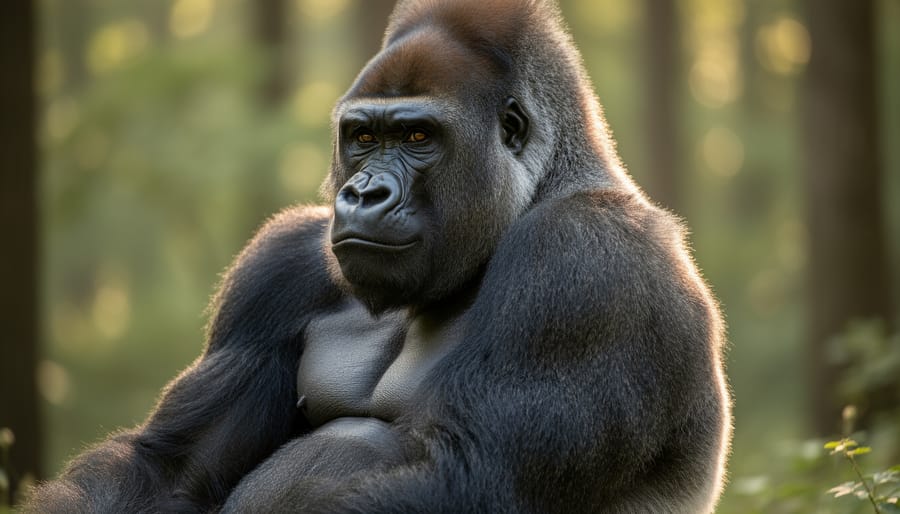
Moving further out on our family tree, gorillas share about 98.3% of our DNA, while orangutans match us at approximately 97%. These percentages might seem only marginally different from chimps, but in genetic terms, they represent millions of years of separate evolutionary history.
Gorillas split from the human-chimp-bonobo lineage roughly 10 million years ago. Despite being our third-closest relatives, they exhibit striking parallels to human behavior: complex social structures, tool use for specific tasks, and remarkable emotional depth. The genetic differences concentrate in areas controlling brain size, skeletal structure, and immune responses, adaptations that allowed gorillas to thrive in dense mountain forests while our ancestors moved toward open grasslands.
Orangutans diverged even earlier, about 15 million years ago, making them our most distant great ape cousins. Their 97% genetic similarity still dwarfs our overlap with any non-ape species. What makes orangutans fascinating is how that 3% genetic difference manifests: they’re the only predominantly arboreal great ape, with extraordinarily long arms and a largely solitary lifestyle, traits controlled by genes regulating limb development and social hormones.
These relationships map a clear evolutionary timeline. Each percentage point of difference corresponds roughly to millions of years of independent evolution, showing how small genetic changes accumulate to produce distinct species while preserving the fundamental blueprint we all share.
Beyond Primates: Unexpected Genetic Cousins
Moving beyond our primate family reveals genetic overlaps that seem almost like science fiction, yet they’re rooted in the deep evolutionary history we share with all life on Earth. Mice, those tiny lab staples, share roughly 85% of our protein-coding genes, a similarity that makes them invaluable for studying human diseases and biological processes. Cats, surprisingly, share about 90% genetic similarity with humans, particularly in genes controlling basic cellular functions and organ development.
Perhaps most startling is the 60% genetic overlap with bananas. Before you question your ancestry, understand what these percentages actually represent: they measure shared fundamental genes that all complex life requires. These are the ancient molecular instructions for basic cellular machinery, energy production, protein synthesis, cell division, that evolved billions of years ago in our common single-celled ancestors.
These comparisons matter because they reveal evolution’s conservative nature. Rather than reinventing the wheel, evolution tweaks existing genetic blueprints. The genes controlling how your cells produce energy are nearly identical to those in a mouse, a cat, or even a plant, because this fundamental process works. What differs are the regulatory genes controlling when, where, and how these shared instructions get expressed, the conductors orchestrating the same basic instruments into vastly different symphonies.
What These Genetic Connections Teach Us
Medical Research and Drug Development
The 98.8% genetic similarity between humans and chimpanzees isn’t just an evolutionary curiosity, it’s the foundation of modern medical research. When scientists develop treatments for cancer, Alzheimer’s, or infectious diseases, they first test them in animals whose biology closely mirrors our own. Mice, sharing 85% of our DNA, serve as living laboratories because their genes often function identically to human genes. If a particular gene causes diabetes in mice, blocking that gene frequently yields similar results in humans.
This genetic kinship explains why primate studies remain crucial for vaccine development and neurological research. When COVID-19 vaccines needed safety testing before human trials, researchers turned to rhesus macaques, our 93% genetic cousins, whose immune systems respond remarkably like ours. The logic is straightforward, much like how easy science experiments demonstrate basic principles: shared genetic code means shared biological machinery.
Drug developers exploit these similarities systematically. A medication’s effectiveness in a genetically similar animal predicts its likely performance in human bodies, saving years of research and countless lives by filtering out dangerous compounds before they reach clinical trials.
Understanding Human Evolution
Comparative genetics operates like an evolutionary time machine, allowing scientists to trace the story of human origins written in our DNA. By comparing genetic sequences across species, researchers identify when different lineages split from common ancestors, chimpanzees diverged from our lineage roughly 6-7 million years ago, gorillas about 10 million years ago, and orangutans around 14 million years ago. These genetic clocks reveal humanity’s ancestral journey through Africa, where our species first emerged, and subsequent migrations across continents as populations adapted to radically different environments.
The genetic footprints left in our DNA tell stories beyond simple ancestry. They show how humans developed lactose tolerance in dairy-farming populations, lighter skin in northern latitudes with less sunlight, and high-altitude adaptations among Tibetan populations. Comparing our genome to extinct cousins like Neanderthals, whose DNA persists in modern non-African populations at 1-4%, reveals interbreeding events that shaped contemporary human genetics. These discoveries spark wonder about our interconnected past while providing concrete evidence of how evolutionary pressures sculpted the human species across hundreds of thousands of years.
The Question of Human Uniqueness
The 1.2% genetic difference between humans and chimpanzees poses one of biology’s most fascinating puzzles: how can such a tiny divergence produce Shakespeare, spacecraft, and symphonies? The answer lies not just in which genes differ, but in how they’re expressed and regulated.
Much of our genetic uniqueness centers on brain development. Humans possess modified versions of genes like FOXP2, linked to language ability, and ARHGAP11B, which influences cortical expansion during fetal development. These tweaks create brains with more neurons, denser neural connections, and extended development periods that allow for complex learning.
Yet genetics alone doesn’t explain human culture. Our capacity for cumulative knowledge, building on previous generations’ discoveries, creates a feedback loop where cultural evolution amplifies biological potential. Chimpanzees can learn, use tools, and pass knowledge to offspring, but they don’t create written languages, universities, or technologies that compound over millennia.
The paradox reminds us that small genetic changes, positioned correctly, can cascade into profound differences. We’re simultaneously another great ape species and something genuinely new, close enough genetically to share most biological machinery, yet distant enough to reshape the planet itself.
How What Animal Are Humans Genetically Closest to Works
The process begins when scientists extract DNA samples from both humans and the target species, typically from blood, tissue, or saliva. Modern sequencing machines then read the chemical letters (A, T, C, G) that make up each genome, generating billions of data points that represent the complete genetic instruction set for each organism.
Computer algorithms align these sequences side by side, searching for matching stretches of DNA. The software identifies regions where the genetic code is identical, similar, or completely different. Think of it like comparing two massive instruction manuals written in the same basic language, some pages will be word-for-word copies, others will have slight variations, and some sections won’t match at all.
The real work happens in the statistical analysis. Researchers count how many genetic letters match between species, then calculate this as a percentage of the total genome. They also look for structural differences: genes that are present in one species but missing in another, genes that have moved to different chromosomes, or sequences that have been duplicated or deleted over evolutionary time.
This same comparative method works across all scales, from complex genetic studies down to simple preschool science demonstrations. Even toddlers science activities use pattern-matching to understand similarities and differences in the natural world.
Common Questions About Human Genetic Similarity
15000
When people first learn that we share 98.8% of our DNA with chimpanzees, questions immediately arise about what this actually means for who we are. These genetic connections spark curiosity about everything from practical biology to deeper philosophical concerns about what makes us human and how we fit into the animal kingdom.
Can genetic similarity predict behavior or intelligence?
Not reliably. While genes influence behavior, the expression of those genes depends heavily on development, environment, and culture. That 1.2% genetic difference, combined with different gene regulation patterns, produces vastly different cognitive abilities and social structures.
Why can’t humans and chimpanzees interbreed if we’re so genetically similar?
We have different numbers of chromosomes (humans have 46, chimps have 48), which creates insurmountable reproductive barriers. Additionally, millions of years of separate evolution have made our reproductive biology incompatible at multiple levels beyond just genetics.
How much DNA do we share with extinct human relatives like Neanderthals?
Modern humans share about 99.7% of DNA with Neanderthals, and many people of European and Asian descent carry 1-2% Neanderthal DNA from ancient interbreeding. Denisovans, another extinct cousin, contributed similar small percentages to some populations.
Does “junk DNA” reveal anything about our animal connections?
What was once called junk DNA often contains regulatory sequences and evolutionary remnants that illuminate our shared history. Comparing these non-coding regions across species helps scientists trace evolutionary relationships and understand how genes are controlled differently in various animals.
The timeline question comes up frequently too. Humans and chimpanzees shared a common ancestor roughly 6 to 7 million years ago, which sounds like forever but represents a relatively recent split in evolutionary terms. Our lineage diverged from gorillas around 10 million years ago, and from orangutans about 15 million years back. These timescales help explain why we’re genetically closer to some species than others, and why certain traits appear across primate groups while others distinguish us.
Perhaps the most persistent misconception is that genetic similarity translates directly to similarity in appearance or capability. The reality proves more nuanced. Small changes in gene regulation, the timing of when genes activate during development, and which genes get expressed in which tissues can produce dramatic differences in outcome. A handful of genetic changes affecting brain development created the cognitive leap that enabled human language, abstract reasoning, and complex culture.
The realization that we share 98.8% of our DNA with chimpanzees does more than satisfy scientific curiosity. It reshapes how we see ourselves in the living world. Those invisible threads of shared genetic code connect us not just to our closest primate relatives, but to the entire tapestry of life that has evolved over billions of years.
As we venture deeper into the genomic age, these connections will likely inform decisions that matter profoundly. Conservation strategies might shift when we recognize that protecting great apes means safeguarding creatures who are, in a very real sense, our biological kin. Medical breakthroughs will continue to emerge from understanding what makes a mouse 85% similar yet completely different, revealing which genetic switches control traits we once considered uniquely human.
But perhaps the most valuable insight isn’t found in the percentages themselves. It’s in the humbling recognition that we’re participants in an ancient, ongoing experiment. The same genetic language that built our capacity for abstract thought also built the chimpanzee’s tool use, the gorilla’s family bonds, and even the basic cellular machinery we share with organisms across the tree of life.
This doesn’t diminish what makes us special. Our art, philosophy, and capacity to ponder these very questions remain extraordinary. Rather, it places our uniqueness in context. We’re not separate from nature, elevated above it. We’re nature expressing itself in one particularly contemplative form, related by biochemistry to everything that has ever lived, distinct in degree rather than kind.
The closer we look at our genetic relatives, the more we find reflections of ourselves, and the more we’re reminded that every species tells part of the same remarkable story.