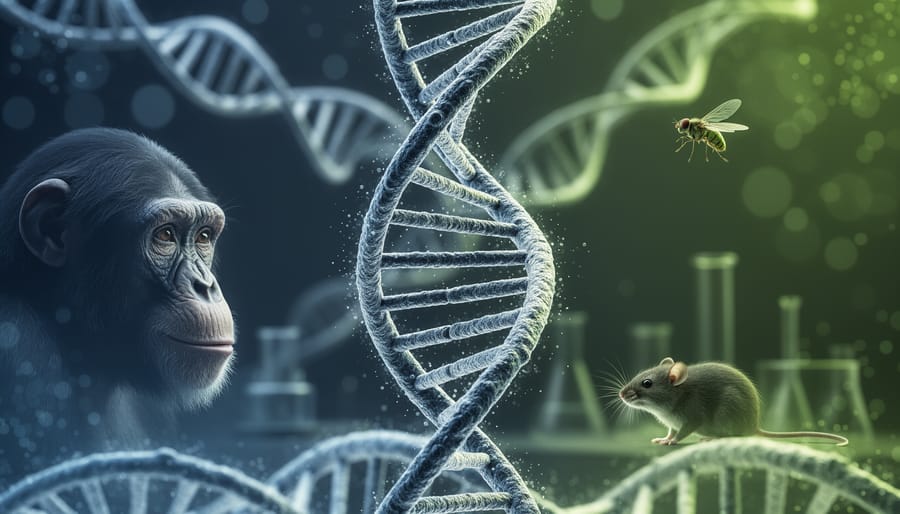
Human genetics is the study of how DNA shapes who we are, from the color of our eyes to our risk of inheriting certain diseases, and how those instructions pass from one generation to the next. Each of us carries roughly three billion base pairs of genetic code, packed into 23 pairs of chromosomes, and about 99.9 percent of it is identical from one person to the next. That tiny remaining fraction is where our individuality lives.
Here’s the part that surprises people. Our genetic story doesn’t stop at the edge of our species. Humans share around 98 percent of their DNA with chimpanzees, and we hold a surprising number of genes in common with mice, fruit flies, and even bananas. That overlap is exactly why animals have become such powerful windows into our own biology, and why human-animal genetics sits at the heart of modern medicine and evolutionary science.
This article walks through what human genetics means in plain language, how genes actually work, the main branches of the field, and how the knowledge is used today. Along the way, we’ll keep established science clearly separated from speculation, because the most interesting questions often sit right on that border.
What Human Genetics Means: Reading the Instruction Manual We Share With Other Life
Human genetics is the study of how traits are written into our cells, passed from parent to child, and shaped by tiny differences in the code. Think of it as reading an instruction manual that every person carries in nearly every cell, and that we happen to share, page by page, with a surprising number of other living things.
That manual is built from DNA, a long molecule that spells out instructions using four chemical letters. Stretches of DNA that carry the recipe for a specific protein or function are called genes. Your DNA is bundled into chromosomes, and the full set of instructions, all 3 billion letters or so, is your genome. Here are the core terms in plain language:
- Gene
- A stretch of DNA that holds the instructions for building a particular protein or controlling a particular job in the body.
- Genome
- The complete set of DNA in an organism, including every gene and all the stretches in between.
- Chromosome
- A tightly packaged bundle of DNA. Humans have 23 pairs, one set from each parent.
- Allele
- One version of a gene. Variation between alleles is why people differ in traits like blood type.
- Mutation
- A change in the DNA sequence, which may do nothing, cause trouble, or occasionally prove useful.
- Homolog
- A gene in one species that matches a gene in another because both descend from the same ancestral gene.
The field’s history is a story of looking sideways at other species. In the 1860s, Gregor Mendel counted pea plants to uncover the basic rules of inheritance. Early in the twentieth century, Thomas Hunt Morgan used fruit flies to show that genes sit on chromosomes. Mice, roundworms, and yeast followed as stand-ins for questions we could not ethically or practically test on people.
Then came the Human Genome Project, which delivered a first draft of our sequence in 2000 and a more complete reading in 2003. Even that landmark leaned on comparison. Scientists sequenced the genomes of mice, flies, and other organisms alongside ours, because a gene that looks the same across species is a strong hint that it matters.
That is why the human-animal link isn’t a sideshow. We share ancestors with every other creature, so we share genes with them too. Reading our own manual almost always means checking the margins where other species left their notes.
How Human Genetics Works: From DNA Code to Living Traits
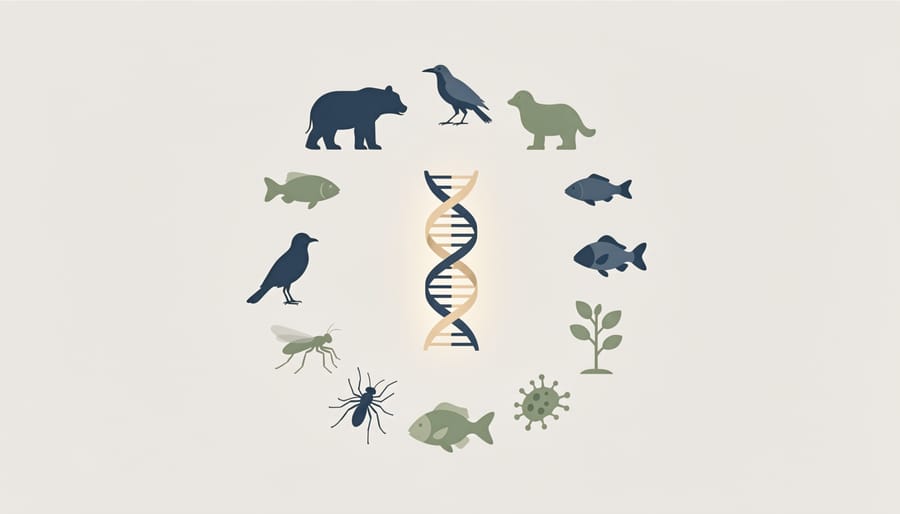
The Inheritance Chain: How Traits Travel Through Generations
Think of a family recipe card passed down by two cooks. You get one copy from each parent, and they don’t always say the same thing. Humans carry 23 pairs of chromosomes, one set from your mother and one from your father, and each pair holds two versions of most genes, called alleles.
When the versions disagree, the dominant allele usually speaks louder. A recessive allele only shows itself when you inherit two copies, which is why a trait can seem to skip a generation, then reappear in a grandchild with the same bright red hair as a great-aunt nobody remembers meeting.
Variety enters the story in two ways. Before an egg or sperm forms, paired chromosomes swap segments in a shuffle called recombination, so the copy you pass on is a remix, never an exact duplicate. Occasionally the copying process also slips, creating a mutation, a tiny typo that may do nothing, cause trouble, or occasionally prove useful.
None of this is uniquely human. The same inheritance machinery runs in mice, fish, and our closest relatives the great apes, which is why watching how traits travel in other animals teaches us so much about ourselves.
Why Old Genes Survive: The Logic of Conservation
Think of a gene as a recipe in a very old family cookbook. Some recipes get rewritten constantly, because a small tweak makes dinner better. Others are never touched, because changing a single ingredient ruins the whole meal. Conserved genes are those untouchable recipes.
The logic is simple: if a gene does a job that every cell or embryo depends on, a mutation in it is usually harmful, and the animals carrying that mutation tend not to pass it on. Natural selection acts like a stern editor, quietly striking out errors. Over hundreds of millions of years, the surviving text stays remarkably similar from one species to the next.
The Hox genes are a classic case. They help lay out the body plan, telling an embryo where the head goes and where the tail goes. Fruit flies, mice, and humans all use versions of them, in much the same order along the chromosome. Genes for building the eye show similar overlap, and so do genes that control how cells divide and repair damaged DNA.
Here is where comparison gets interesting. Conserved genes show us kinship, but the small differences around them show us how we diverge. A mouse and a person share a nearly identical gene, yet the switches that turn it on, and for how long, can differ. That is why researchers can study a mouse gene to learn about human health, while still being careful not to assume the story ends there.
The Many Faces of Human Genetics and Our Animal Relatives
Comparative Genomics: Measuring Kinship Across Species
Comparative genomics works like proofreading two manuscripts side by side. Scientists take the human genome, line it up against the chimpanzee, mouse, zebrafish, and other genomes, and mark where the letters match, where they differ, and where whole passages have been shuffled or deleted. The matches point to inherited instructions. The differences show where lineages drifted apart.
You’ve probably seen the headline numbers: humans share roughly 98 to 99 percent of their DNA with chimpanzees, around 85 percent of protein-coding sequence with mice, and a large majority of genes with zebrafish. These figures are real, but they measure different things. A percentage might count only single-letter swaps in aligned regions, or it might include insertions and deletions, or it might compare only genes rather than the whole genome. That’s why calculating similarity can mislead when a single number is quoted without its method.
A high percentage also doesn’t mean “almost the same animal.” A small number of changes in the right regulatory switches can reshape a brain or a skeleton. Meanwhile, large stretches of chimpanzee and human DNA are identical without telling us much about what makes each species distinct.
The real payoff comes from asking which sequences stayed locked in place and which changed fastest. For a closer look at how we know our nearest relatives, the methods matter as much as the results. And if the idea of rewriting a creature’s code sparks your imagination, science-inspired fiction has been exploring those questions for generations.
Ancient DNA and Deep Ancestry
In 2010, a tiny finger bone from Denisova Cave in Siberia gave up its secrets, and with them, a whole new branch of the human family tree. The DNA inside belonged to a population nobody had known existed. Soon after, researchers sequenced Neanderthal genomes and discovered something stranger still: many people alive today carry their code.
That finding blurs a line we once thought was crisp. Instead of a clean break between “human” and “other,” ancient DNA shows overlapping populations that met, mingled, and had children. Most people with non-African ancestry carry roughly one to two percent Neanderthal DNA, while some populations in Oceania carry traces of Denisovan DNA too. A fascinating study of Neanderthal and Denisovan admixture even suggests that only a small slice of our genome is uniquely modern human, though that figure depends heavily on how “unique” is defined.
Some of these inherited fragments appear to matter. Certain variants have been linked to immune responses and altitude adaptation, hinting that borrowed code helped our ancestors survive new environments.
So deep ancestry reframes the question. Rather than asking where animals end and humans begin, genetics invites us to see a braided river of lineages, flowing together and apart across hundreds of thousands of years.
Epigenetics, Viruses, and Borrowed Code
Our genome is not just a list of genes. It also carries a layer of instructions about when and where those genes get used. That layer is epigenetics: chemical tags, such as methyl groups attached to DNA, that act like sticky notes on the text, telling cells to read a passage loudly, quietly, or not at all. Many of these regulatory systems are shared with other animals, which is partly why a mouse liver cell and a human liver cell can behave so similarly.
Then there is the borrowed code. Roughly eight percent of human DNA traces back to endogenous retroviruses, remnants of viruses that infected our ancestors and slipped into egg or sperm cells millions of years ago. Most are now fossils, mutated beyond function, and cells use epigenetic silencing of ERVs to keep the rest quiet. A few have been repurposed. A viral-origin gene called syncytin helps build the placenta in mammals, a handy bit of ancient recycling.
What’s established: these insertions exist, and some do real jobs. What’s still debated is how much of the remaining viral DNA matters, and how far epigenetic marks can be passed between generations in humans. Those answers are still being written.
How Human Genetics Is Used: From Mouse Models to Medicine and Beyond
Human genetics earns its keep in the real world, and much of that payoff comes from the animal connections we’ve been tracing. Because so many of our genes have close counterparts in other species, researchers can study a disease in an animal and learn something true about ourselves.
Mouse models are the classic example. Mice share most of their protein-coding genes with us, and scientists can switch off a single gene to see what breaks. When a mouse missing a particular gene develops symptoms resembling a human condition, it points researchers toward the cause. Zebrafish play a similar role because their embryos are transparent, letting scientists watch organs form in real time. Fruit flies, humble as they are, have helped reveal how basic developmental genes work.
That research feeds directly into treatment. Gene therapy aims to deliver a working copy of a faulty gene into a patient’s cells, and every step of its development leaned on animal testing before reaching people. Genetic testing now lets doctors check for inherited risks, and the same comparative logic helps interpret what a given variant might do. Consumer ancestry tests use related ideas, comparing your DNA to reference populations, though the results are statistical estimates rather than verdicts. If you enjoy hands-on discovery, there are simple experiments you can try at home that capture some of the same curiosity, such as extracting DNA from fruit with kitchen supplies.
Genetics also protects wildlife. Conservation geneticists measure the diversity within endangered populations to spot inbreeding, then guide breeding programs and relocations that keep species resilient. The tools built to read our genome work just as well on a snow leopard’s.
Then come the harder questions. Scientists have created chimeras, organisms carrying cells from two species, mostly to study development and grow tissue. Xenotransplantation, using genetically modified animal organs for human patients, has seen early clinical experiments with pig hearts and kidneys. Both raise serious ethical debates about animal welfare, disease transfer, consent, and where the boundaries should sit. Regulators and ethicists are still working through them, and the answers are far from settled.
A thought experiment (pure speculation): Imagine a future where a hospital keeps a herd of gene-edited animals, each one bred so its organs match a specific patient’s immune profile. A waiting list shrinks overnight. But the same herd raises an unsettling question: if a body part grows in an animal, whose story does it carry? This is fiction, not forecast, yet it shows how quickly a scientific possibility becomes a human dilemma.
Common Questions About Human and Animal Genetic Connections
Are humans really 98 percent chimpanzee?
Not quite. The familiar figure usually refers to how closely the DNA letters line up in the regions that can be compared directly, and it shifts depending on what gets counted, such as insertions, deletions, and duplicated stretches. Even a small percentage gap covers millions of differences, and a handful of those shape how brains and bodies develop very differently.
Why do scientists use mice to study human disease?
Mice and humans share most of their protein-coding genes, and many core biological pathways work in similar ways. Mice also breed quickly and can be studied under tightly controlled conditions, though results do not always carry over to people, which is why findings are always tested further.
Do we share genes with plants and fungi?
Yes. Genes that run basic cell chores, like copying DNA and turning food into energy, are so useful that they have been preserved for well over a billion years. This is why researchers can learn about human cells by studying yeast.
Is a genetic test the same as a family tree?
No. A genetic test reads patterns in your DNA and compares them with reference groups to estimate ancestry or flag health-related variants, while a family tree is built from documents and recorded relationships. The two can complement each other, but neither one replaces the other.
Behind every one of these questions sits the same lesson: similarity in genetics is a matter of degree, not a simple yes or no. Where a popular claim sounds too tidy, it usually hides a more interesting story about what is being measured and how.
Human genetics, stripped to its core, is a story about inheritance, and that inheritance was never ours alone. The same chemical alphabet that spells out your eye color also runs through the cells of a mouse, a zebrafish, and the yeast rising in a bread dough. We carry instructions that were drafted long before our species existed, copied faithfully across millions of years, and edited only here and there along the way.
What makes that idea powerful is how much of it remains open. Scientists are still working out why a few small changes made us distinct, and which of our borrowed pieces of code do jobs we haven’t yet understood.
So keep asking. Look at a pet, a bird at the window, even a houseplant, and remember there’s a thread running from it straight back to you. Pull on that thread, and see where it leads.