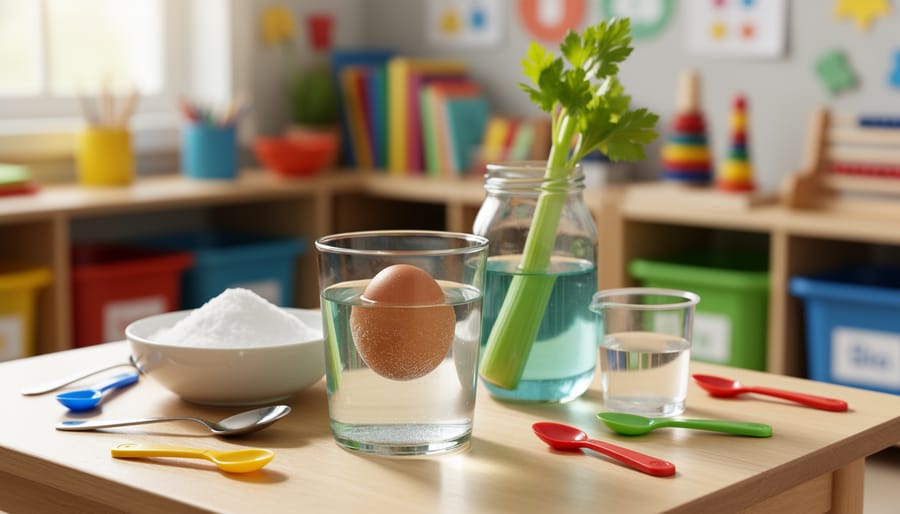
Kindergarten science experiments can be as simple as mixing baking soda and vinegar, floating an egg in salt water, or watching a celery stalk drink colored water. These activities require household items, take 10 to 20 minutes, and deliver the kind of immediate, visible results that turn five-year-olds into wide-eyed investigators. The magic lies not in complex lab equipment but in choosing experiments that balance safety, simplicity, and spectacle.
Young children learn science best through touch, observation, and surprise. At this developmental stage, they’re natural experimenters, testing gravity with every dropped spoon and exploring cause-and-effect with every light switch. Structured experiments channel that innate curiosity into moments of genuine discovery. When a child sees a seed sprout after days of careful watering, or watches oil refuse to mix with water no matter how hard they stir, they’re not just entertained. They’re building the foundational thinking patterns that underpin scientific reasoning: prediction, observation, and the understanding that the physical world follows patterns we can investigate.
The experiments in this collection were selected for materials you already own, minimal supervision requirements, and outcomes clear enough for kindergartners to grasp. Each offers a chance to introduce vocabulary like “reaction,” “density,” or “dissolve” in context, transforming playtime into a stepping stone toward lifelong scientific literacy. Whether you’re a parent seeking weekend activities or a teacher planning classroom stations, these experiments prove that wonder doesn’t require a PhD, just the willingness to ask “what happens if” alongside a curious child.
What Makes a Science Experiment Perfect for Kindergarten
Not every activity labeled “science” belongs in a kindergartener’s hands. The experiments that truly work for five- and six-year-olds share a handful of non-negotiable traits, and recognizing them saves you from Pinterest disasters and teary frustration.
Start with safety that doesn’t demand hovering. The best kindergarten experiments use materials you’d trust them with during snack time, no open flames, no chemicals that sting, no glass that shatters. A child should be able to explore without you holding their wrist the entire time. Next, simplicity matters more than spectacle. If the instructions require more than five steps, you’ve lost them. Their working memory can juggle maybe three actions before the sequence blurs, so “pour, stir, watch” beats “measure precisely, heat gently, time for four minutes while noting temperature changes.” The payoff needs to arrive fast, too. Kindergarteners live in the immediate present; a bean sprout that emerges in five days might as well be five years. They need to see bubbles rise, colors swirl, or objects float within minutes, not tomorrow.
Common household materials keep the barrier to entry low. Baking soda, food coloring, paper towels, and spare change beat ordering specialty kits that arrive late or cost more than the wonder they deliver. Finally, embrace observation over precision. The goal isn’t replicating lab conditions but sparking questions. Did the raisin dance? Why did the milk explode in colors? Perfection kills curiosity; mess and surprise feed it.
The criteria that separate genuine kindergarten experiments from wishful thinking:
- Safe without constant supervision, no hot surfaces, caustic liquids, or breakable glass
- Three to five simple steps maximum, matching a young child’s working memory
- Immediate visible results within minutes, not hours or days
- Common household materials requiring no specialty orders
- Encourages observation and wonder over precise measurement or replication
- Engages multiple senses, seeing, touching, sometimes smelling or hearing
Developmentally, kindergarteners thrive on sensory engagement. They learn by touching, watching things change state, hearing fizz, feeling texture shift under their fingers. The scientific method at this age distills to wonder-ask-try-see. They notice something curious, voice a question (even if it’s just “What happens if…?”), perform a simple action, then observe the result. That’s the entire arc. You’re not teaching hypothesis testing or control variables; you’re teaching them that their questions have answers they can discover themselves, and that the world responds in predictable, delightful ways when they poke at it gently.
15 Experiments That Deliver Instant Magic
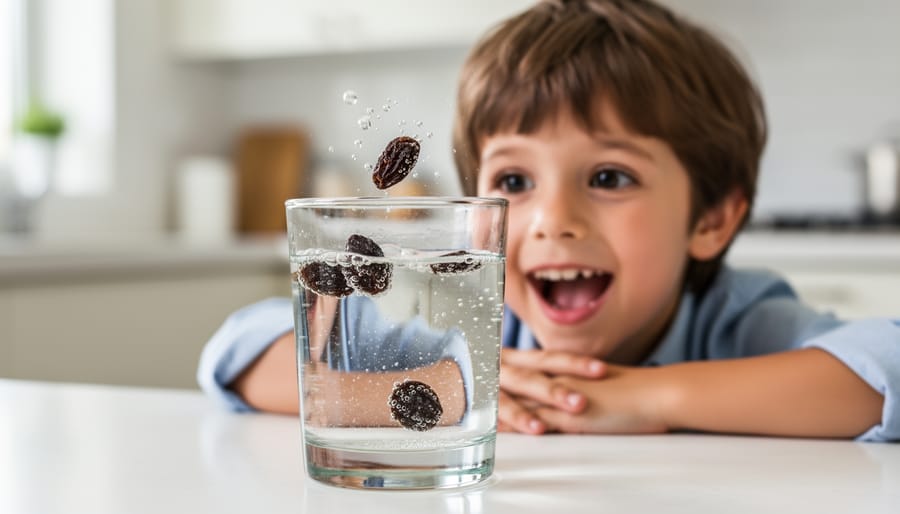
1. Dancing Raisins (Carbon Dioxide Bubbles)
Raisins bob up and down in sparkling water like tiny deep-sea divers on a mission. Fill a clear glass with club soda or any carbonated water, drop in five or six raisins, and watch as carbon dioxide bubbles latch onto the raisins’ wrinkled surfaces. The bubbles act like tiny life jackets, pulling the raisins up to the surface. Once the bubbles pop and release into the air, the raisins sink back down, only to collect more bubbles and rise again. This dance continues until the water goes flat, usually five to ten minutes. Children see cause and effect in real time: bubbles equal lift, no bubbles equal sink. The wrinkles matter too; smooth grapes don’t work as well because CO2 needs texture to cling to. It’s a living lesson in gas, density, and buoyancy, packaged in a glass that costs pennies.
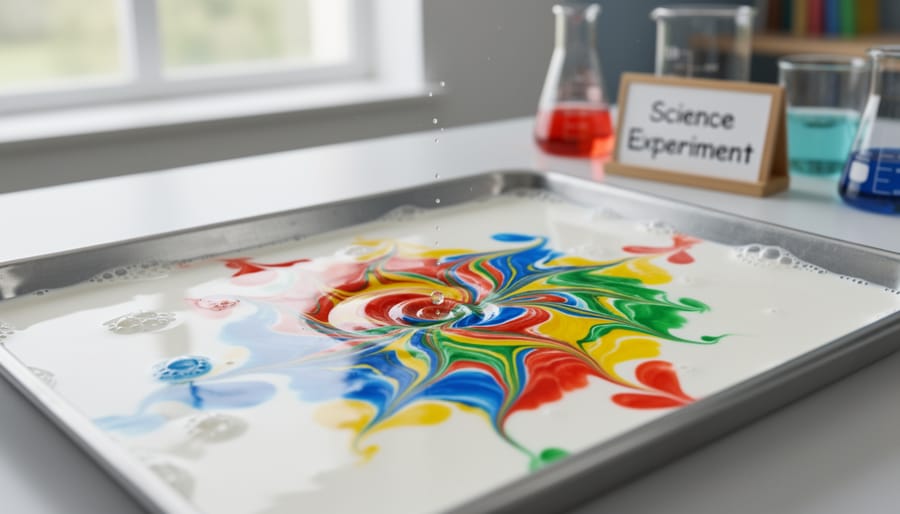
2. Magic Milk Colors (Surface Tension)
Pour whole milk into a shallow dish until it covers the bottom, about half an inch deep works perfectly. Drop four or five dots of different food colors around the milk’s surface, spacing them out like tiny paint puddles. Now for the magic: dip a cotton swab into dish soap and touch the tip to the center of the milk. The colors explode outward in swirling rivers and spirals, racing away from the soap like they’re fleeing a tiny wizard’s wand.
This happens because milk has a skin-like surface held together by molecules clinging to each other, that’s surface tension. Dish soap breaks those bonds instantly, and the milk’s fat and protein molecules scramble away from the disruption, dragging the food coloring along for the ride. Touch the soap to different spots and watch the colors dance again and again, each time creating new patterns that kindergarteners can describe, predict, and wonder about.
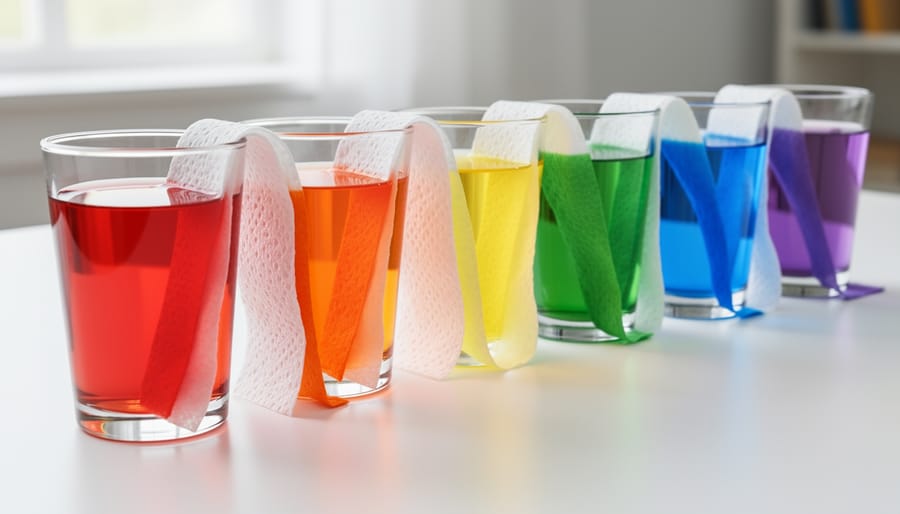
3. Walking Water Rainbow (Capillary Action)
What You’ll See: Three glasses of water, one red, one yellow, one blue, connected by paper towel bridges that slowly drink the colors from cup to cup until new colors appear in the empty spaces between them. In two hours, you’ll have a six-color rainbow.
What You Need: Six clear cups, three colors of food coloring (red, yellow, blue), water, and paper towels.
How to Do It: Fill every other cup halfway with water. Add red to the first, yellow to the third, blue to the fifth. Leave cups 2, 4, and 6 empty. Fold paper towels lengthwise into strips and drape one end into each filled cup, the other into the neighboring empty cup. Wait.
Why It Works: Paper towels are woven from thousands of tiny plant fibers with microscopic gaps between them. Water molecules cling to these fibers and to each other, climbing upward against gravity through the gaps, a process called capillary action. The colored water travels up one towel, across the top, and down into the empty cup, carrying its color along. Where yellow meets blue, green appears. Magic is just physics moving slowly enough to watch.
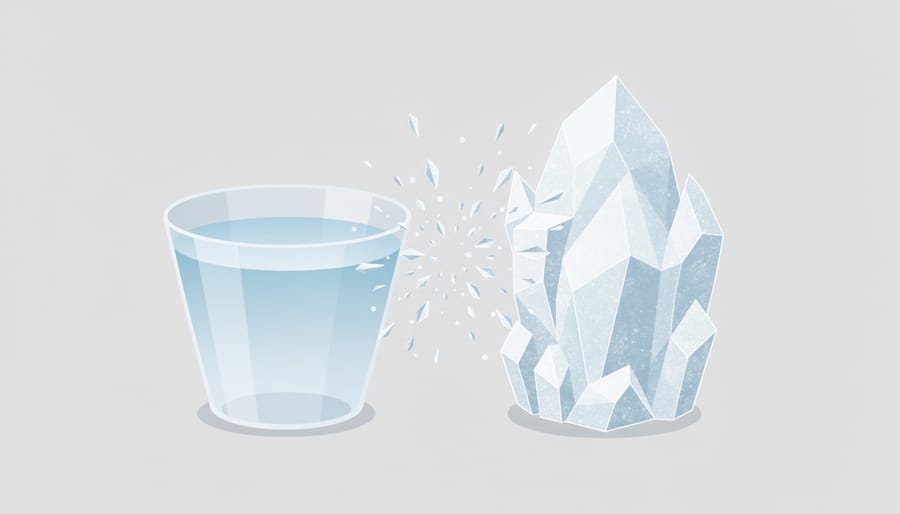
4. Instant Ice (Supercooling)
What you’ll see: Water transforms into ice crystals before their eyes, no freezer needed in the moment, just a tap or a stir.
What you need: Purified or distilled water bottles (unopened), your freezer, a bowl of ice, and patience.
How to do it: Place unopened bottles of purified water in the freezer for exactly two hours and forty-five minutes (test your freezer first, timing varies). Remove them gently, without shaking. Pour slowly over ice in a bowl or tap the bottle sharply against the counter. The water freezes instantly into slush.
Why it works: Pure water can chill below freezing without solidifying if it stays perfectly still, a state called supercooling. The moment you introduce vibration or a nucleation point (like ice crystals or rough surfaces), it snaps into ice. For kindergarteners, it’s magic that teaches waiting, precision, and the hidden rules of temperature.
5. Balloon Rocket (Newton’s Third Law)
What You’ll See: A balloon races along a string like a rocket launching across your living room, propelled by nothing but escaping air.
What You Need: One balloon, tape, drinking straw, at least ten feet of string or yarn, two chairs.
How to Do It: Thread the string through the straw and tie one end to each chair, pulling it taut. Blow up the balloon without tying it, tape it lengthwise to the straw (with the opening facing backward), then let go. The balloon shoots forward as air rushes out the back.
Why It Works: When air pushes out one direction, the balloon pushes back the opposite way, Newton’s third law in action. Rockets work the same way, whether they’re headed to space or zooming across your kitchen.
6. Invisible Ink (Oxidation)
Squeeze lemon juice into a bowl, dip a cotton swab or paintbrush in it, and let your kindergartener write or draw on white paper. Once the lemon juice dries, it’ll be invisible, carefully hold the paper near (but not touching) a warm light bulb or iron set on low heat. Adult supervision is essential here. Within seconds, brown writing magically appears. The heat speeds up oxidation, causing the sugars in the lemon juice to caramelize and turn brown, revealing the secret message. It’s spy work meets chemistry, and children love the suspense of waiting for their hidden words to emerge.
7. Floating Egg (Density and Buoyancy)
Fill a clear glass halfway with tap water and gently lower in an egg, it sinks straight to the bottom. Now stir in salt, tablespoon by tablespoon, and watch the egg slowly rise until it hovers mid-water or floats at the surface like a tiny submarine deciding whether to dive or surface.
You’ll need: one raw egg, two clear glasses, tap water, table salt (about six tablespoons), and a spoon. Fill the first glass with plain water and place the egg inside, it sinks. In the second glass, dissolve salt into the water until the egg lifts. For extra drama, layer fresh water gently on top of salt water in a single tall glass and watch the egg float between layers.
The magic is density. Freshwater is less dense than the egg, so gravity pulls the egg down. Salt water is denser, the dissolved salt adds mass without much volume, so it pushes back harder, creating enough buoyant force to hold the egg up. Kindergarteners see it as the water “getting stronger,” which is exactly right: salty ocean water holds swimmers up better than a lake, and this egg proves it in under five minutes.
8. Celery Color Sponge (Plant Vascular System)
Celery stalks become living straws in this gentle introduction to plant biology. Fill two glasses halfway with water, add different food colors (red and blue work beautifully), then trim the bottom inch off fresh celery stalks and place one in each glass. Within hours, colored lines appear in the stalk; by the next morning, the leaves sport the same hue. Slice the stalk crosswise and children see tiny dots, the xylem tubes that carried water upward. It works because plants pull water from roots to leaves through these microscopic highways, and food coloring simply tags along for the ride. The wonder here is visible proof that plants drink, just differently than we do. No rushing required; this experiment rewards patience and transforms a snack vegetable into a scientific storyteller.
9. Static Electricity Butterfly
Rub a balloon vigorously against a sweater or your hair for 20 seconds, then hold it near small tissue-paper butterfly cutouts on a table. The butterflies leap up and cling to the balloon, wings trembling as if alive. Your kindergartener just discovered static electricity, the invisible force that makes socks stick in the dryer and hair stand on end in winter. Friction transfers electrons from fabric to rubber, giving the balloon a negative charge that attracts the neutral tissue paper. Kids love watching the butterflies “fly” and stick, and you can extend the magic: try different materials (foil, paper scraps, cereal flakes) to see what else the charged balloon pulls. The experiment works best on dry days when humidity is low, turning a simple rubbed balloon into a wand of scientific wonder.
10. Skittles Science (Diffusion)
Arrange Skittles in a circle on a white plate, one of each color works best, then pour warm water into the center until it barely covers the bottom. Within seconds, the candy shells dissolve outward in brilliant streaks of red, orange, yellow, green, and purple, each color staying in its lane like a stained-glass window made of sugar. Kindergarteners watch, mesmerized, as the dyes migrate through the water, creating a rainbow that feels almost deliberate in its symmetry. The science at work is diffusion: molecules of dye spread from areas of high concentration (the candy) to low concentration (the clear water), and because the water remains still, each color moves outward without immediately mixing. The warm temperature speeds the dissolving, making the effect instant enough to hold a five-year-old’s attention. This experiment asks for nothing more than a handful of candy, a plate, and patience, yet it delivers a visual story about how substances travel, spread, and eventually blend, turning a simple snack into a lesson about motion at the molecular level.
11. Penny Boat (Surface Tension Challenge)
Children fold aluminum foil into tiny boats and drop pennies inside one at a time, watching the foil dip lower with each coin. The boat floats, until suddenly it doesn’t, and water rushes over the edges. The question isn’t whether the boat will sink, but *when*, and that unpredictability turns a simple physics lesson into a competitive game.
– Aluminum foil (regular kitchen foil)
– A large bowl or basin filled with water
– 20-30 pennies (or other coins)
Tear off a piece of foil about six inches square. Fold up the edges carefully to create a shallow boat shape with sides about half an inch tall. Gently place the boat on the water surface, it should float. Now add pennies one by one, counting aloud. Watch the boat settle deeper after each addition. Keep going until water spills over the sides and the boat sinks.
Water’s surface acts like a thin, stretchy skin called surface tension. The foil boat spreads its weight across that skin, and the folded edges trap air underneath, creating buoyancy. As you add pennies, the boat displaces more water and sits lower. Eventually, the weight overcomes both the surface tension and the boat’s ability to push water aside, gravity wins, and down it goes.
12. Baking Soda Volcano (Acid-Base Reaction)
What You’ll See: Pour vinegar into a mound of baking soda and watch it erupt in a fizzing, foaming rush, like a tiny mountain coming alive. The reaction is instant, dramatic, and endlessly repeatable, making this the experiment kindergarteners beg to do again.
What You Need: Baking soda, white vinegar, a small plastic cup or dish, and optionally red food coloring to make ‘lava.’
How to Do It: Pile two tablespoons of baking soda into the cup. Add a drop of food coloring on top if you want colored foam. Pour in a quarter cup of vinegar and step back as the mixture erupts in bubbles and fizz, spilling over the sides.
Why It Works: Vinegar is an acid and baking soda is a base. When they meet, they react and create carbon dioxide gas, the same gas in your breath and in soda bubbles. The gas forms so fast it pushes the mixture up and out, creating the eruption. The foam is just trapped bubbles, harmless and fun to touch once the fizzing slows. Kids can repeat this a dozen times, varying the amounts to see bigger or gentler eruptions, and each time they’re watching chemistry happen right in front of them.
13. Magnetic Cereal Hunt (Magnetism and Iron)
What you’ll see: A magnet tugs iron-fortified cereal pieces through water like invisible fish following a lure.
What you need: Iron-fortified cereal (check the label for iron content, most breakfast flakes have it), a clear bowl, water, a strong magnet, and a resealable plastic bag.
How to do it: Place a handful of cereal into the bag and crush it into small pieces. Pour the crushed cereal into the bowl and add enough water to cover it. Let it sit for a few minutes so the flakes soften. Now move the magnet slowly along the outside of the bowl, tiny dark specks will follow it like magic. If you hold the magnet still, the specks cluster against the glass exactly where the magnet waits.
Why it works: Many breakfast cereals add iron, an actual metal, to boost nutrition. When you crush the cereal and soak it, that iron becomes loose enough for a magnet to attract. The dark bits trailing your magnet are real iron particles that were hiding in your breakfast all along. It’s the same metal that makes nails stick to magnets, now small enough to swim through water.
14. Cloud in a Jar (Condensation)
What You’ll See: A misty cloud forms inside a clear jar, just like the clouds floating in the sky outside, kindergarteners watch weather happen right in their hands.
What You Need: A glass jar, very hot water (adult pours), a plate, ice cubes, and hairspray or aerosol spray.
How to Do It: Pour about an inch of hot water into the jar and swirl it around to warm the glass. Place the plate upside-down on top of the jar’s opening and stack three or four ice cubes on the plate. Wait thirty seconds, then lift the plate slightly and spray a quick burst of aerosol into the jar before sealing it again with the plate. Within moments, a fluffy white cloud appears inside the jar, swirling and dancing against the glass.
Why It Works: Clouds form when warm, moist air rises and cools. The hot water creates humidity, the ice chills the air at the top, and the aerosol particles give water vapor tiny surfaces to cling to, just like dust and pollen do in the real sky. When these ingredients meet, condensation happens, and you’ve made a miniature weather system.
15. Oobleck Mystery (Non-Newtonian Fluid)
Mix two parts cornstarch with one part water in a bowl, and watch kindergarteners’ faces light up as they discover something that defies what they know about liquid and solid. Press the mixture hard and it resists like dough; relax your hand and it drips like milk. Let them punch it, squeeze it, poke it slowly, oobleck behaves differently every time. This happens because the cornstarch particles jam together under sudden pressure, creating temporary solidity, then flow apart when the force stops. Dr. Seuss named it in *Bartholomew and the Oobleck*, but the science is real: non-Newtonian fluids change viscosity based on stress. Add food coloring for extra fun, and ask your kindergartener whether oobleck is a liquid or solid. The answer, both and neither, is their first glimpse into substances that refuse simple categories, a perfect final experiment that turns certainty into wonder.
Beyond the Kitchen Table: Science Programs That Bring the Lab to Kids
While the fifteen experiments above turn your kitchen into a laboratory, some families and educators want structured guidance, a weekend workshop where someone else marshals the supplies, or an after-school program that stretches discovery across weeks. In 2026, several organizations deliver exactly that, blending professional facilitation with kindergarten-appropriate wonder.
Mad Science remains a stalwart, offering hands-on STEM after-school programs for kids ages 5-12, plus birthday parties, workshops, and summer camps. Their facilitators arrive with props and scripted demonstrations, think dry ice fog or tabletop tornadoes, designed to wow while explaining core principles. It’s showmanship married to pedagogy, perfect for children who thrive in a group setting.
Scientists in School operates across Canada with both online and onsite workshops. For virtual sessions, they ship mini science bags filled with investigative materials ahead of time, ensuring each kindergartener has real objects to manipulate on screen. The model bridges distance without sacrificing tactile learning, a balance between curiosity and evidence that respects how five-year-olds actually learn.
The Home Depot hosts free Kids Workshops on the first Saturday of each month, usually focused on building projects but occasionally featuring simple machines or magnetism activities. They’re drop-in and no-cost, making them accessible experiments in community-based learning.
STEMstein Academy offers themed workshops like their Winter Science Workshop (ages 8-11, though younger siblings often participate), featuring instant frost art, snow globes, snowy oobleck, and invisible ink. The seasonal framing helps children connect science to their lived experience, winter isn’t just cold; it’s a laboratory.
These structured options work best when viewed as complements to home tinkering, not substitutes. The wonder versus facts tension that defines great science learning happens in both settings, but the kitchen table holds one irreplaceable advantage: the child leads, the parent follows, and mistakes become stories rather than failures.
What We’ve Learned: Science as Storytelling for Little Minds
The fifteen experiments we’ve explored share a common thread: each one transforms a question into a story. When a kindergartener watches raisins dance or touches oobleck that defies simple categories, they’re not learning isolated facts about carbon dioxide or non-Newtonian fluids. They’re learning that the world responds to curiosity, that wondering leads somewhere, and that the permission to ask what if is the most valuable gift we can offer young minds.
Across these experiments, we’ve covered chemical reactions, physics principles, states of matter, plant biology, and magnetism. But the variety matters less than the pattern it establishes: science lives everywhere, not just in labs. A kitchen becomes a chemistry station. A bathroom sink demonstrates air pressure. The same cornstarch that thickens gravy turns into a substance that refuses to behave predictably.
When experiments go sideways, the celery refuses to change color, the egg cracks in salt water, the balloon rocket sputters, the real learning often begins. Children who embrace the mess and ask why something didn’t work as expected are practicing scientific thinking more authentically than those who follow instructions to flawless results. Let them lead with their questions. Follow their tangents. The fifteen experiments here aren’t endpoints but invitations to a conversation between what is known and what might be discovered, between fact and imagination, that can last a lifetime.
Common Questions About Kindergarten Science Experiments
How long should each experiment take?
Most of these experiments unfold in five to ten minutes, which matches a kindergartener’s attention span perfectly. The magic happens quickly enough to hold their focus, but leaves room for repeated trials if curiosity takes over.
What if my child loses interest halfway through?
Let them. Science isn’t a performance, and sometimes the most important discovery is realizing you’re done exploring for now. Return to it tomorrow or try a different experiment that catches their eye.
Are these safe without hovering constantly?
Yes, with the exception of Invisible Ink, which requires an adult with the iron. The others use food-safe materials and involve no heat, sharp objects, or toxic substances. Set up nearby and let them lead.
How do I explain the science without overcomplicating it?
Follow their questions rather than delivering a lecture. If they ask why the raisins dance, you might say “tiny bubbles stick to the raisins and give them a ride up,” then stop. Let wonder do more work than words.
Can these work in a classroom with 20 kids?
Absolutely. Pair students, pre-portion materials into cups or bowls, and run two or three experiments as stations so children rotate through. The simplicity of these activities makes classroom chaos manageable.
Do I need to buy special science supplies?
Not for these. Everything lives in your pantry, bathroom, or recycling bin already. The only item you might need to pick up is clear sparkling water for the Dancing Raisins, and even that’s optional if you skip that one.
These questions reflect what parents and teachers actually wonder when they’re standing in the kitchen at 4 p.m. or planning Friday’s classroom activity. The answers matter because they remove the invisible barrier between “sounds fun” and “let’s actually do this.” Kindergarten science succeeds when adults trust that messiness, brevity, and even abandonment midway through are all part of the process. The experiments themselves are forgiving, the materials are humble, and the real goal is simply to normalize asking “what happens if?” in a world that often demands certainty before curiosity.