Fall science experiments transform everyday autumn materials into powerful learning moments. Fallen leaves reveal plant biology and decomposition processes. Pumpkins become vessels for chemical reactions and physics demonstrations. The season’s cooler temperatures and changing natural environment create perfect conditions for hands-on discovery that connects scientific principles to observable phenomena right outside your door.
These seasonal experiments require minimal preparation and use items you already have or can gather during an afternoon walk. A maple leaf teaches chromatography as effectively as laboratory equipment. A few apples demonstrate oxidation. The crisp October air provides natural refrigeration for studying states of matter.
The beauty of autumn-themed science lies in its accessibility and relevance. When children see the concepts they’re exploring reflected in the world around them, abstract ideas become tangible. The leaf that changed color on the tree becomes the subject of chlorophyll extraction. The frost on morning grass transforms into a lesson on crystallization and temperature.
Parents and educators searching for meaningful activities will find these experiments bridge the gap between classroom theory and lived experience. They work equally well for kindergarteners taking their first steps into scientific thinking (much like these easy science experiments) and older students ready to explore deeper concepts.
The following experiments harness what makes fall scientifically fascinating: organic decomposition, atmospheric changes, harvest abundance, and the visible transformation of the natural world. Each activity includes clear explanations of the underlying science, so learners understand not just what happens, but why.
Why Fall Is Perfect for Science Exploration
Fall transforms the natural world into an open-air classroom where chemistry unfolds in leaf color, physics governs seed dispersal, and biology drives visible decomposition cycles. The experiments in this collection weren’t chosen randomly, they reflect deliberate criteria that make autumn uniquely suited for hands-on scientific exploration.
The seasonal shift provides both the raw materials and the observable phenomena that bring abstract concepts to life. When you can hold a crimson leaf and extract the pigments hidden beneath its summer green, or watch a pumpkin become a bubbling chemical reaction, science stops being theoretical and becomes tangible. Fall’s cooler temperatures slow certain processes enough to observe them, while accelerating others in ways that summer’s heat obscures.
These eight experiments met specific selection standards:
- Materials readily available during autumn months without specialty ordering
- Accessible procedures suitable for various age groups and skill levels
- Clear demonstration of fundamental scientific principles across multiple disciplines
- Direct connection to seasonal changes observable in backyards and parks
- Opportunities for genuine inquiry rather than cookbook-style following of steps
The intersection of biology, chemistry, and physics during autumn creates natural laboratories everywhere you look. Temperature fluctuations between day and night trigger chemical changes in leaves. Gravity and air resistance determine how seeds travel. Moisture levels control how organisms respond to their environment. These aren’t isolated phenomena, they’re interconnected systems where plants and senses interact with physical forces to create the autumn landscape. Each experiment capitalizes on this convergence, turning seasonal abundance into scientific investigation.
1. Leaf Chromatography: Unveiling Hidden Pigments
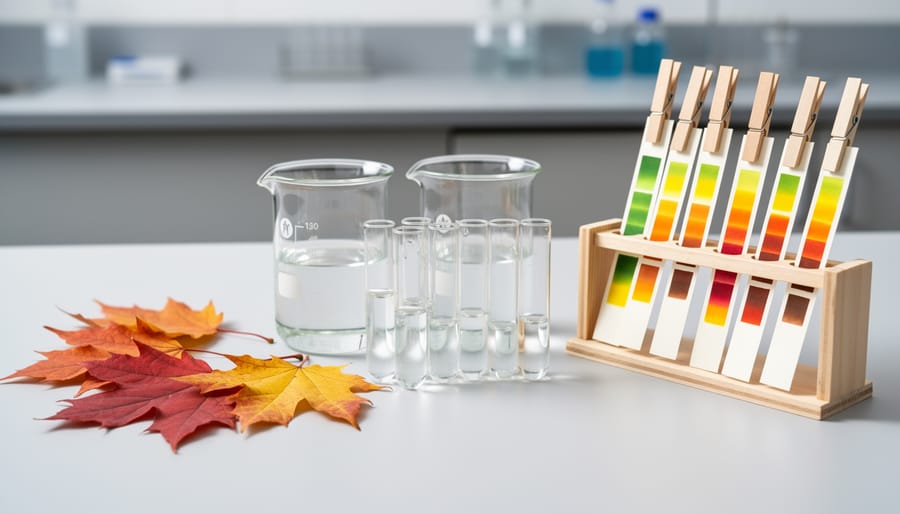
Tear a handful of vibrant fall leaves into small pieces, drop them into rubbing alcohol, and within hours you’ll witness autumn’s secret palette emerge. Leaf chromatography separates the pigments hidden beneath a leaf’s green summer coat, revealing the yellows and oranges that were there all along, masked by chlorophyll’s dominance.
The procedure is straightforward. Place torn leaf pieces in a glass jar with enough rubbing alcohol to cover them, then set the jar in hot water for thirty minutes. The alcohol extracts pigments from the leaf tissue. Next, cut a coffee filter into strips, dip one end into the pigment-rich alcohol, and watch capillary action pull the liquid up the paper. As it travels, different pigments separate based on their molecular weight and solubility. Heavier molecules cling near the bottom while lighter ones ride higher, creating distinct color bands.
What you’re seeing are the carotenoids (yellows and oranges) and anthocyanins (reds and purples) that live in the leaf year-round. During growing season, chlorophyll floods leaf cells to capture sunlight for photosynthesis, drowning out these other hues. As autumn days shorten and temperatures drop, trees stop producing chlorophyll. The green fades, and the warm tones shine through.
Some trees manufacture anthocyanins specifically in fall, producing those brilliant scarlet maples. Others, like birches and poplars, rely solely on their existing carotenoids for yellow displays. The chromatography strip becomes a chemical fingerprint, showing not just what colors you see on the tree, but which pigment molecules created them and why different species produce different autumn spectacles.
2. Pumpkin Volcano: Acid-Base Reactions in Action
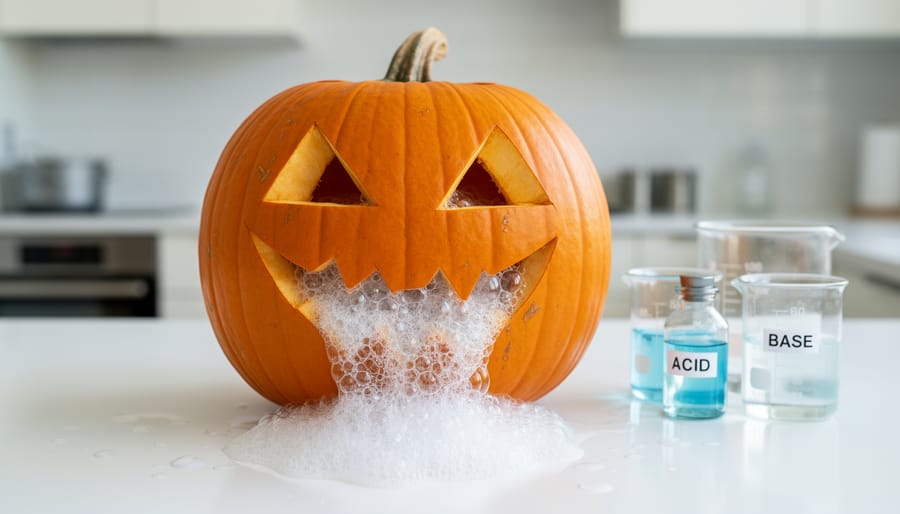
A hollowed pumpkin makes a spectacular vessel for one of chemistry’s most reliable reactions. Carve a wide opening at the top, similar to preparing a jack-o-lantern, and scoop out the seeds and pulp to create a clean chamber. Pour about half a cup of baking soda into the bottom, then add a squirt of dish soap and a few drops of food coloring if you want a more dramatic effect. When you pour in vinegar, the pumpkin erupts with fizzing foam that spills over the sides.
The eruption happens because vinegar (acetic acid) reacts with baking soda (sodium bicarbonate) to produce carbon dioxide gas. The chemical equation shows one molecule of acetic acid combining with sodium bicarbonate to yield sodium acetate, water, and CO₂. The gas forms rapidly, creating thousands of bubbles that get trapped by the soap, producing the foamy overflow. The reaction is exothermic, meaning it releases a small amount of heat, though you likely won’t feel it through the pumpkin’s thick walls.
Real volcanoes operate on entirely different principles, molten rock forced upward by tectonic pressure, not chemical reactions, but the visual comparison helps illustrate gas expansion and pressure release. In both cases, gas buildup creates force that must escape. You can extend the experiment by testing different acids (lemon juice, citric acid solution) or varying the baking soda quantity to see how reaction vigor changes. The pumpkin shell contains the mess while adding seasonal flair to a classic demonstration of acid-base chemistry.
3. Apple Oxidation Investigation
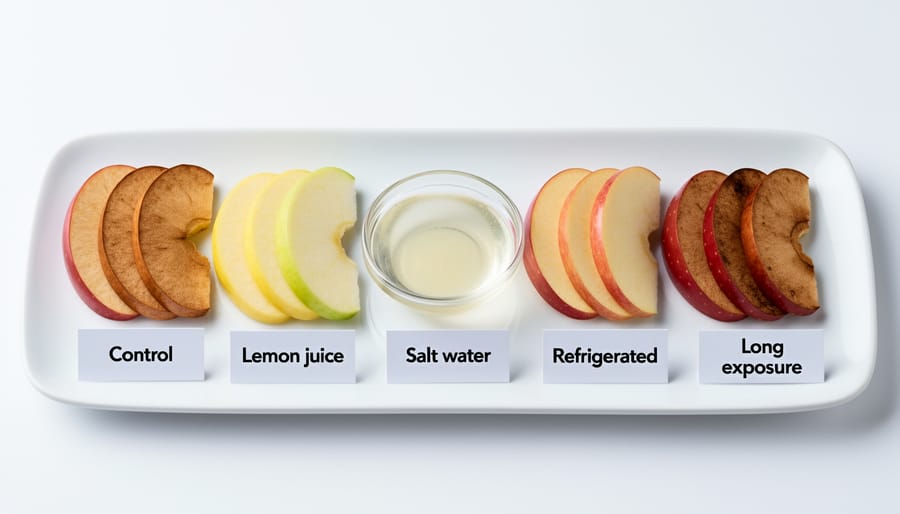
Slice an apple at the peak of autumn’s harvest, and within minutes you’ll witness chemistry in action as the exposed flesh turns an unappetizing brown. This enzymatic browning offers a perfect controlled experiment to explore oxidation, enzyme activity, and practical food science, all with equipment you already have in your kitchen.
The star of this transformation is polyphenol oxidase, an enzyme stored in apple cells. When you cut through the fruit, you rupture cell walls and allow the enzyme to meet oxygen and phenolic compounds that were previously separated. The enzyme catalyzes a reaction between these phenols and oxygen, producing quinones, brown-colored molecules that further polymerize into the melanin pigments responsible for that characteristic discoloration. It’s the same chemical family that colors human skin and hair.
Set up your investigation by preparing identical apple slices and treating each with a different preservation method: leave one exposed as your control, brush another with lemon juice, submerge a third in cold water, coat one with honey, and wrap another tightly in plastic wrap to exclude air. Check them at five-minute intervals for the first half hour, then at longer intervals.
The results reveal multiple intervention strategies. Lemon juice works because its citric acid denatures the polyphenol oxidase enzyme and lowers pH below the enzyme’s optimal range. Cold water slows the reaction rate by reducing molecular energy and limiting oxygen contact. Honey creates a barrier while its natural antimicrobial compounds inhibit enzyme activity. Plastic wrap simply prevents oxygen from reaching the fruit’s surface, no oxygen, no oxidation.
This experiment demonstrates that enzymatic reactions require specific conditions and can be disrupted through temperature, pH, physical barriers, or enzyme deactivation.
4. Temperature Layering with Harvest Liquids
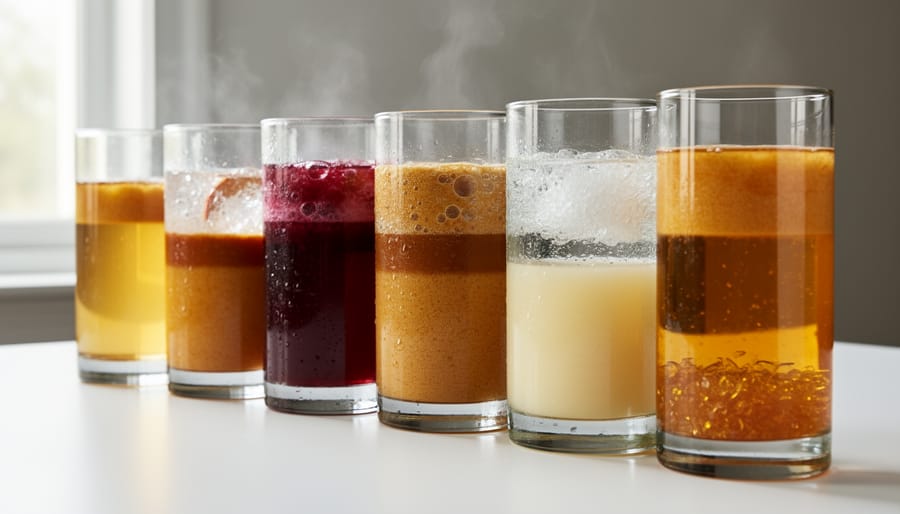
Pour equal amounts of apple cider into three clear glasses, but treat each differently: leave one at room temperature, heat the second in the microwave for 30 seconds, and refrigerate the third for 15 minutes. Once your liquids reach noticeably different temperatures, slowly pour them into a tall, narrow container in order from coldest to warmest. If you angle the container and pour down the side gently, you’ll see distinct layers form where the beverages meet.
The cold cider sinks because its molecules move sluggishly, packing closer together and increasing density. The warm cider floats on top as heat energizes its molecules, making them spread apart and become less dense. The room-temperature layer settles in between, creating a visible gradient that demonstrates how thermal energy controls molecular behavior. You can enhance the effect by adding a drop of food coloring to each temperature batch before layering, turning the physics into a striking autumn-colored display.
This experiment works beautifully with cranberry juice, pear juice, or any seasonal beverage dark enough to show contrast. The layers stay separated for several minutes before convection currents gradually mix them, giving you time to observe and photograph the phenomenon. It’s accessible enough for preschool science activities yet sophisticated enough to introduce concepts like thermocline layers in lakes and oceans, where temperature differences create distinct zones that affect aquatic life and water circulation.
5. Decomposition Time-Lapse Study
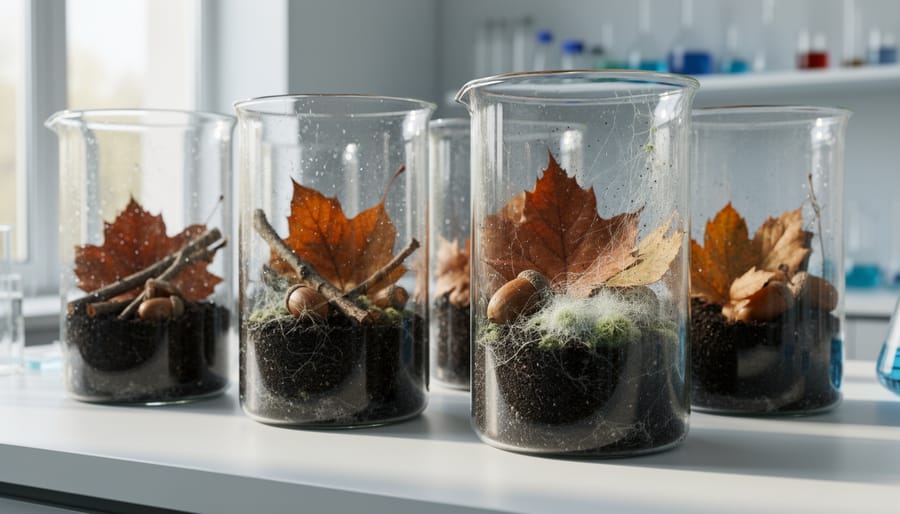
Decomposition transforms the visual drama of autumn into a slow-motion lesson in ecology. Gather an assortment of fall materials, oak leaves, maple leaves, acorns, small twigs, perhaps a few apple slices, and set up observation containers to track their breakdown over four to six weeks. Clear plastic containers work well because you can observe changes without opening them, but punch small holes in the lids for air circulation. Label each container with the material type and start date, then photograph your specimens from the same angle weekly.
What you’re witnessing is nature’s recycling system in action. Bacteria and fungi colonize the dead plant matter first, breaking down cell walls and releasing enzymes that turn complex organic compounds into simpler molecules. You’ll notice white or gray fuzzy growth on some leaves, that’s fungal mycelium doing its work. Leaves with higher lignin content, like oak, decompose more slowly than softer maple leaves, giving you a comparative study in chemical composition. Acorns might sprout before they rot, demonstrating how some materials resist decomposition through protective shells and germination strategies.
The nitrogen, phosphorus, and carbon locked in these autumn castoffs don’t vanish, they return to the soil, feeding next spring’s growth. Your containers become miniature compost systems, revealing how fallen leaves aren’t waste but essential fuel for forest renewal. By week three or four, you’ll see significant texture changes: leaves becoming brittle or slimy, colors shifting from vibrant to brown-black, and volume shrinking as structure collapses. This quiet transformation powers every woodland ecosystem.
6. Seed Dispersal Wind Tunnel
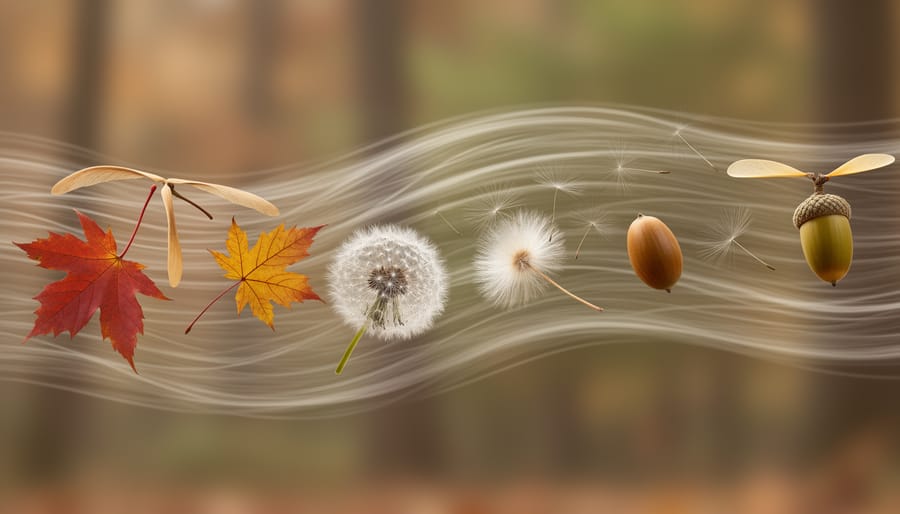
A cardboard box, a desk fan, and a collection of fall seeds can reveal evolution’s elegant engineering. Building a simple wind tunnel lets you test how nature has optimized different seeds for airborne travel, turning your kitchen table into an aerodynamics laboratory.
Start by cutting both ends off a long cardboard box (appliance boxes work perfectly) and positioning a fan at one end. Place a sheet of dark paper on the floor beneath the tunnel to catch seeds after flight. Collect your test subjects: maple samaras with their helicopter blades, fluffy dandelion parachutes, heavy acorns, and ash tree seeds with their paddle-shaped wings. Drop each seed type from the same height at the tunnel’s entrance while the fan runs at consistent speed, timing how long each stays aloft and measuring how far it travels.
The results tell stories written in plant genetics over millions of years. Maple samaras spin as they fall, creating lift that can carry them a hundred yards from the parent tree. That rotation isn’t random, DNA evidence shows how incremental mutations shaped wing angles and seed weights to maximize dispersal distance. Dandelion seeds, weighing almost nothing, drift on air currents like microscopic parachutes, while acorns plummet straight down, trading flight for protective mass that deters predators.
Try varying fan speeds to simulate different wind conditions, or test wet versus dry seeds to see how moisture affects flight. Each adjustment reveals how terminal velocity, the speed where air resistance balances gravity, determines where a seed will establish the next generation.
7. Frost Crystal Formation Experiment
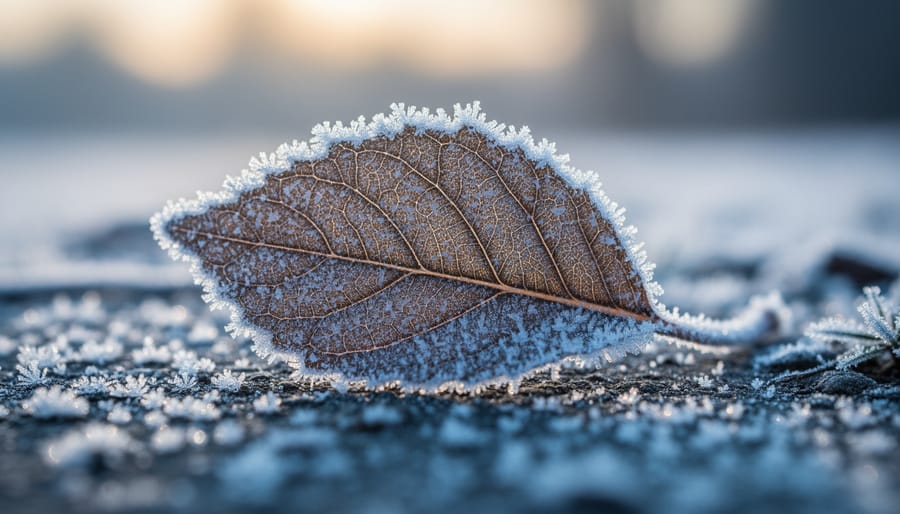
Frost transforms autumn mornings into crystalline galleries, and you can recreate this delicate process indoors with materials already in your kitchen. This experiment captures the moment when water vapor transitions directly to ice, bypassing the liquid phase through a process called deposition, the same mechanism that creates those intricate patterns on car windshields and windowpanes.
Start by placing fresh leaves (broad specimens like oak or maple work best) in a shallow metal pan. Fill a larger container with ice and salt, creating a super-chilled bath that drops the temperature well below freezing. Set the pan with leaves on top of this ice-salt mixture, then cover everything loosely with plastic wrap to trap humidity. As the metal conducts cold to the leaf surfaces, water vapor in the trapped air will begin crystallizing directly onto the leaves, forming delicate frost patterns within 20-30 minutes.
The crystals grow outward from nucleation sites, tiny imperfections, ridges, or particles on the leaf surface where water molecules first anchor themselves. Unlike snowflakes, which form in clouds where water droplets freeze around dust particles and tumble through varying temperatures, frost crystals grow horizontally across surfaces in relatively stable conditions. This creates feathery, branching patterns called dendrites that follow the leaf’s natural texture rather than the six-sided symmetry of falling snow.
For best results, experiment with different leaf textures and humidity levels. Misting the air before covering creates more dramatic crystal formation, though be prepared for a science-friendly mess as condensation accumulates. The crystals melt quickly once exposed to room temperature, so document your observations immediately, this ephemeral quality mirrors the fleeting beauty of real autumn frost.
8. Pinecone Weather Predictor
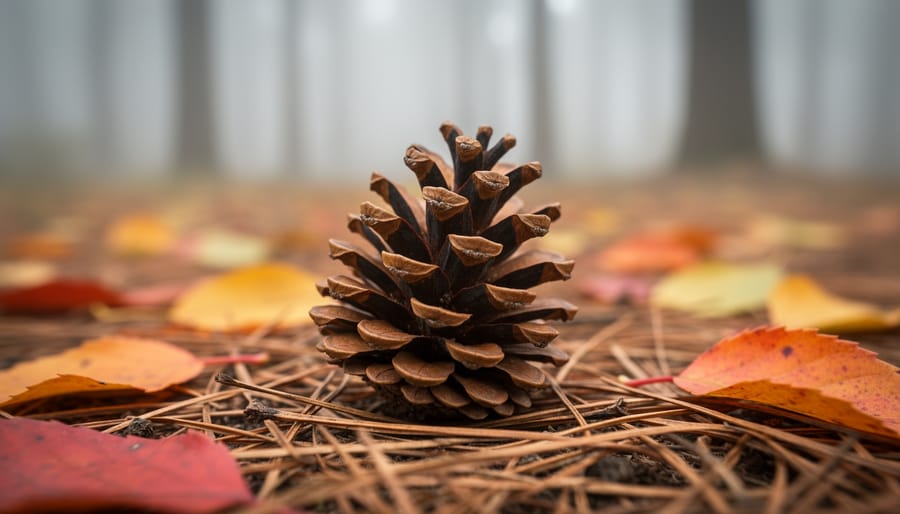
Pinecones carry their own survival instructions written in moisture. Place a closed pinecone on a windowsill during humid weather, and you’ll watch its scales tighten and clamp shut. Move that same cone to a warm, dry room, and within hours the scales peel back and open wide. This repeating transformation turns every pinecone into a natural weather instrument, responding to atmospheric humidity with mechanical precision.
The science centers on hygroscopy, the ability of certain materials to absorb water vapor from surrounding air. Pinecone scales contain cellulose fibers arranged in two distinct layers. The outer layer’s fibers run lengthwise along each scale, while the inner layer’s fibers orient perpendicular to this direction. When humidity rises, the outer layer absorbs moisture and swells, forcing the scales to curl inward and close. Dry conditions reverse the process as the outer layer releases moisture and contracts, pulling the scales outward.
This mechanism protects the cone’s seeds. Wet weather keeps scales sealed, preventing seeds from falling into soggy soil where fungal growth threatens germination. Dry, breezy conditions trigger opening, releasing seeds when wind can carry them farther and soil conditions favor sprouting.
Create your hygrometer by collecting several dry, open pinecones. Mark each cone’s current state with tape, then expose different cones to varying humidity levels: place one near a steaming kettle, another in a closed jar with damp paper towels, and a control cone in normal room air. Check every two hours, photographing the changes. The cone exposed to steam will close fastest, often within thirty minutes, demonstrating how quickly plants can engineer environmental responses without nerves or brains.
Frequently Asked Questions
What age group are these fall science experiments suitable for?
Most of these experiments work well for ages 6 and up with appropriate supervision, though older students can dive deeper into the scientific principles. Younger children will enjoy the hands-on observation aspects, while teens can explore variables, form hypotheses, and connect results to broader scientific concepts.
Do I need special equipment for fall science experiments?
Nearly all autumn science activities rely on household items like jars, bowls, coffee filters, and measuring spoons paired with seasonal materials you can collect outdoors. The beauty of fall experiments is their accessibility, you likely have most supplies already, and nature provides the rest.
How can I document these experiments for learning purposes?
Keep a simple observation journal with sketches, photos, and notes about what you see changing over time. For decomposition and crystal experiments especially, dated entries create a visual record that makes scientific processes tangible and helps learners notice patterns they might otherwise miss.
Can these experiments connect to school science standards?
Yes, these activities align with core concepts in life science, chemistry, and physics that appear across elementary and middle school curricula. Teachers and homeschoolers can use them to illustrate scientific method, properties of matter, biological processes, and environmental science in memorable, season-specific ways.
These questions address the practical concerns readers face when moving from inspiration to action. Once you have gathered your materials and chosen an experiment, the real discovery begins with the first observation, whether that is watching pigments separate on filter paper or noticing how a pinecone responds to morning humidity. The questions and uncertainties that arise during these activities often lead to the most valuable learning moments, where curiosity transforms into understanding.
Bringing Science and Season Together
The experiments in this collection share a common thread: they transform fall from a backdrop into an active participant in the learning process. When you extract pigments from a crimson maple leaf or watch a pumpkin erupt with foaming carbon dioxide, you’re not just performing steps from a procedure. You’re engaging with the same chemical reactions, physical forces, and biological processes that shape the season itself. The leaf didn’t change color for your chromatography experiment, but examining its hidden pigments reveals why October hillsides blaze with unexpected oranges and purples.
This approach mirrors how science actually works. Observation comes first, then questions, then systematic investigation. A pinecone closing before rain isn’t folklore, it’s hygroscopic response. Frost patterns on morning leaves aren’t random, they’re crystallization following predictable physical laws. By anchoring experiments in the season’s genuine transformations, you build understanding that extends beyond any single activity. Fall becomes a renewable resource for curiosity, where every walk through October woods might spark the next question worth investigating. The laboratory was always there, written in falling leaves and cooling air, waiting for someone to look closer.